 trivedi associate July 28, 2026
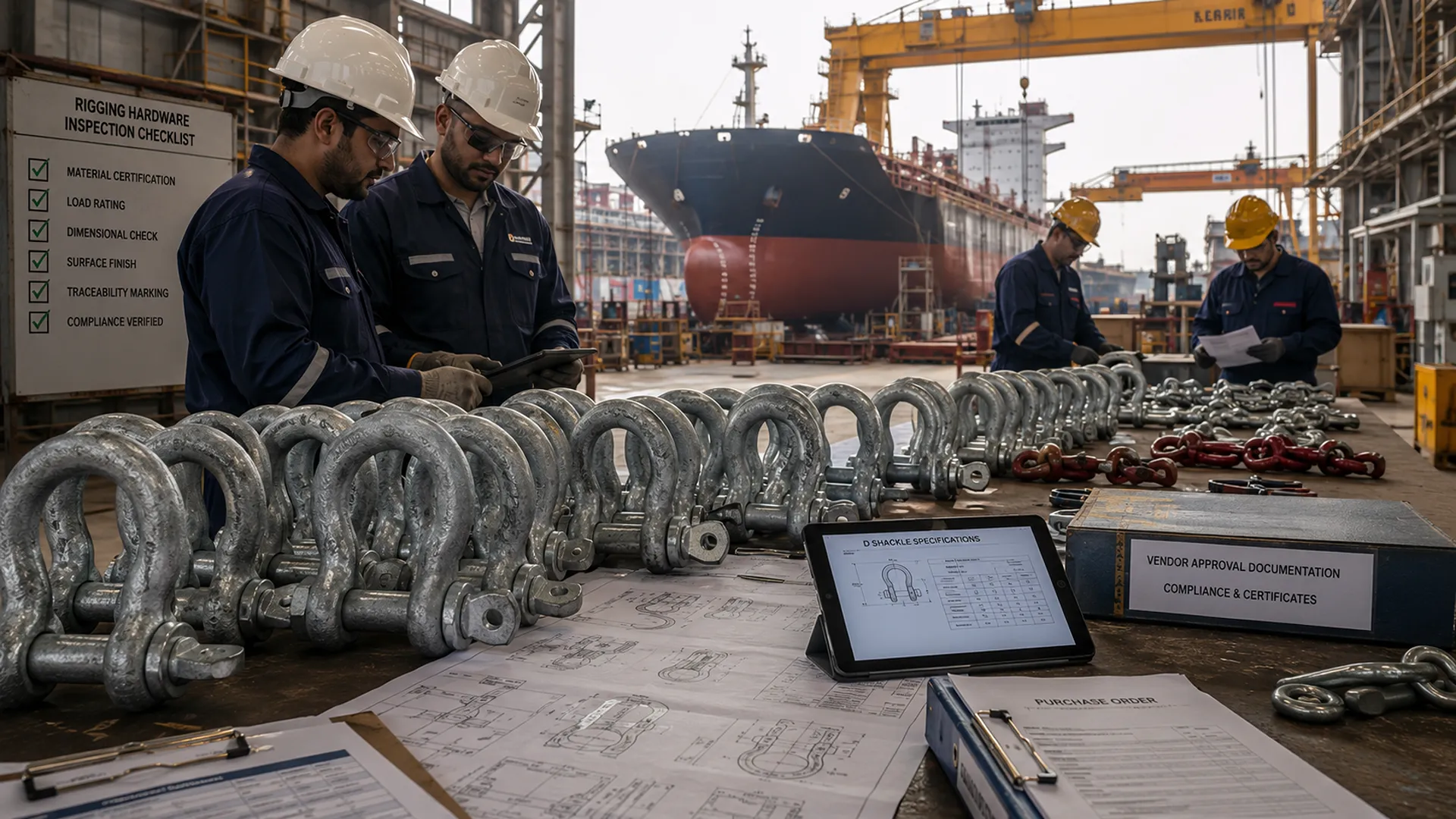
Finding a D shackle bulk supplier for shipyards is about much more than comparing prices or downloading a product catalogue. Shipyards operate in a highly regulated environment where every lifting component can affect safety, compliance, and project schedules. Purchasing teams must evaluate product specifications, certification, supplier reliability, inspection requirements, and total landed cost before placing an order. This guide is designed specifically for shipyard procurement professionals. It walks through the complete buying process—from defining technical requirements and verifying documentation to assessing suppliers and avoiding costly procurement mistakes—so you can make informed, audit-ready purchasing decisions.
Why Shipyard D Shackle Procurement Is Different from Standard Rigging Purchases
Buying D shackles for a shipyard is very different from sourcing lifting hardware for general industrial applications. Marine projects often have stricter quality requirements because the equipment may be used in safety-critical lifting operations and must perform reliably in demanding offshore and coastal environments.
One major difference is compliance with vessel classification society requirements. Depending on the project, documentation and testing may need to satisfy organisations such as ABS, DNV, or Lloyd’s Register, in addition to applicable international or national standards. Procurement teams should always confirm the project’s technical specifications before selecting a supplier.
Procurement timelines also vary between newbuild and MRO (maintenance, repair and overhaul) projects. Newbuild programmes typically follow planned procurement schedules with long lead times, allowing buyers to coordinate bulk orders alongside other marine equipment. MRO projects, however, often require faster purchasing decisions because repairs or maintenance may be linked to vessel downtime, making product availability and delivery speed important factors.
Shipyard procurement also involves challenges that are rarely addressed in generic industrial rigging guides. D shackles used in marine environments are regularly exposed to saltwater, humidity, and corrosive conditions that can affect long-term performance. In addition, shipyards may undergo customer, regulatory, or quality audits where traceability, inspection records, material certificates, and test documentation are reviewed. Choosing a supplier that understands these marine-specific requirements helps reduce compliance risks and supports safer lifting operations throughout the vessel’s lifecycle.
Shipyard Procurement Checklist — The Buyer’s Workflow, Step by Step
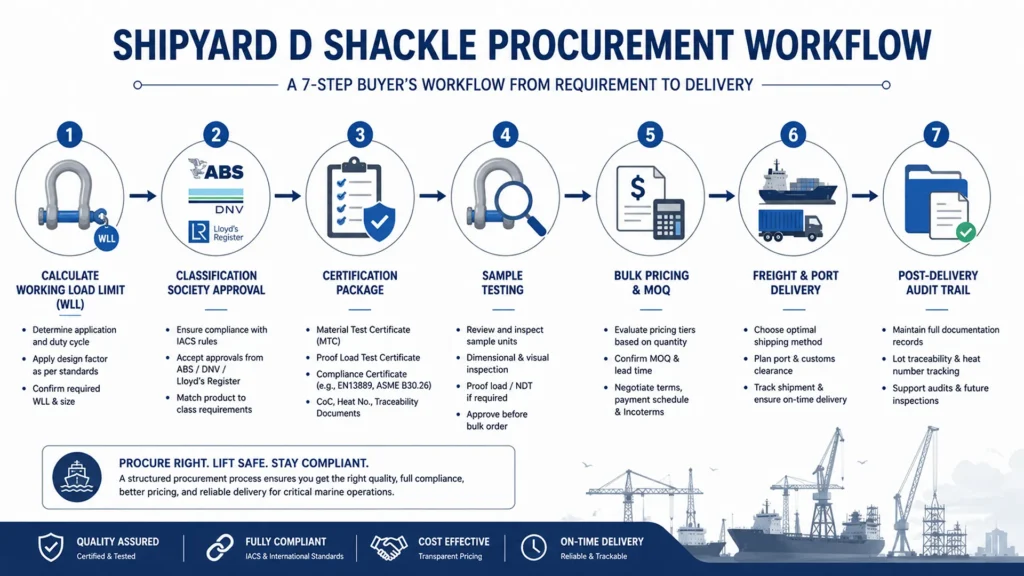
Buying lifting hardware for a shipyard is more than comparing prices. A structured procurement process helps ensure the equipment meets safety standards, project requirements, and documentation needs before it reaches the site. The following workflow reflects the practical steps many procurement teams follow when sourcing lifting components for marine and shipbuilding operations.
Step 1 — Calculate Working Load Limit (WLL) Requirements
Start by determining the maximum load the equipment will handle. The Working Load Limit (WLL) should always match the intended lifting application, with allowance for the weight of rigging accessories where applicable.
For many general lifting applications, lifting equipment is designed with a 4:1 safety factor, while certain critical lifting operations may require a 6:1 safety factor or other specifications depending on project requirements and applicable standards. The required safety factor should always be confirmed before purchasing.
Step 2 — Confirm Classification Society Approval Needed
Next, verify whether the project requires approval from a classification society.
Approval may be mandatory for vessels built or repaired under organisations such as ABS, DNV, or Lloyd’s Register. For routine maintenance or non-classed applications, third-party classification approval may not always be required, although quality certification is still recommended.
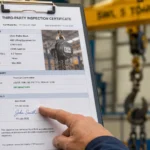
Step 3 — Request the Certification Package
Before placing an order, ask the supplier for a complete documentation package. This commonly includes:
- Mill test certificates
- Batch test reports
- Material traceability records
- Product inspection documents
- Any required compliance certificates
Reviewing these documents before dispatch helps avoid delays during inspection.
Step 4 — Sample Testing Before Bulk Commitment
For larger purchases, request a small sample batch first. Testing representative products allows the shipyard to verify dimensions, finish, documentation, and overall quality before committing to a full shipment. This step can reduce the risk of receiving a large batch that fails inspection or does not meet project specifications.
Step 5 — Confirm Bulk Pricing Tiers & MOQ
Discuss pricing based on expected order volume. Suppliers often provide better rates as order quantities increase, while also specifying a Minimum Order Quantity (MOQ) for certain products or customised orders. Understanding these pricing tiers helps procurement teams plan budgets more effectively.
Step 6 — Plan Freight, Packaging & Delivery
Shipping arrangements are just as important as product quality. Confirm:
- Delivery schedule and destination port
- Export packaging suitable for marine transport
- Corrosion protection during transit
- Labelling for easy warehouse identification
Proper packaging helps minimise damage caused by moisture, salt exposure, and rough handling.
Step 7 — Post-Delivery Audit Trail
After delivery, organise all procurement records in one place. Keep purchase orders, certificates, inspection reports, delivery notes, and supplier correspondence together. A well-maintained audit trail simplifies future compliance reviews, warranty claims, repeat orders, and internal quality audits while providing clear evidence that the purchased equipment met the required procurement standards.
Documentation & Compliance — What Shipyard Buyers Must Verify
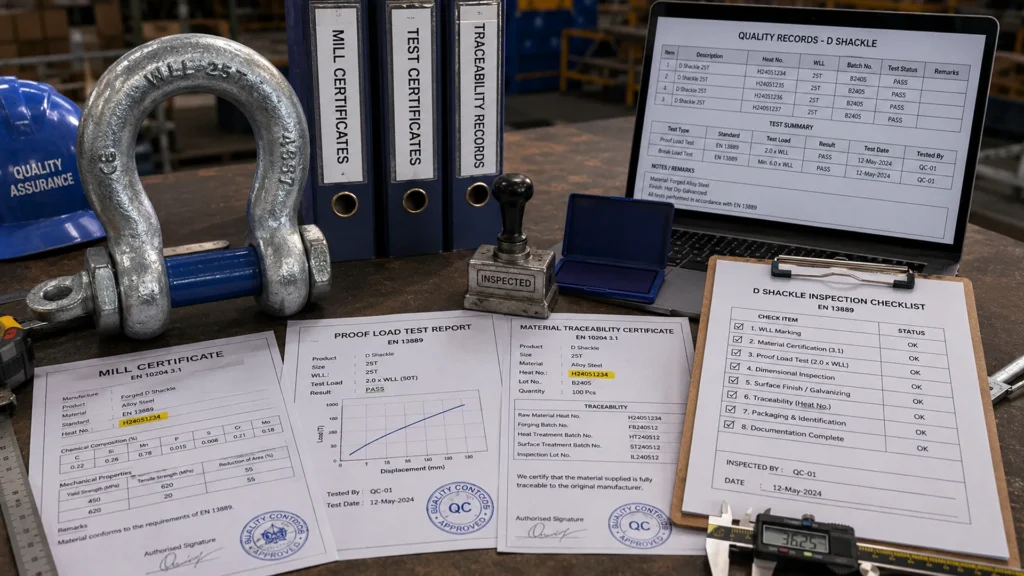
When buying marine anchor chains, the paperwork is just as important as the product itself. A chain may look strong, but without proper documentation, there is no reliable way to confirm its material quality, manufacturing history, or compliance with recognised standards. Shipyards, vessel owners, and procurement teams should always review the supporting documents before accepting delivery.
Mill Certificates and Material Traceability
A genuine mill certificate provides evidence that the steel used in the chain matches the specified material requirements. It also allows the material to be traced back to its production batch.
A proper mill certificate should typically include:
- Heat number or batch number for traceability
- Material grade
- Chemical composition of the steel
- Mechanical properties such as tensile strength and yield strength
- Manufacturer’s name and production date
- Reference to the applicable manufacturing standard, where relevant
The heat number is particularly important because it links every chain component to the original steel production batch. This traceability is valuable if quality issues need to be investigated later.
Standards Mapping: Which Certification Applies to Which Vessel Class
Different standards cover different aspects of marine lifting and anchoring equipment. Understanding their purpose helps buyers verify that the supplied chain is suitable for the intended application.
- RR-C-271 – A long-established specification covering welded chain requirements used in various industrial and marine applications.
- EN 13889 – Specifies requirements for forged steel shackles commonly used with lifting and marine rigging systems.
- ISO 2415 – Covers dimensions and requirements for anchor chains used on ships.
In addition to these standards, many commercial and classed vessels require approval from classification societies such as ABS, DNV, or Lloyd’s Register. These approvals provide an additional level of independent verification based on the vessel’s classification requirements.
Batch Testing & Proof Load Documentation
Proof-load testing confirms that manufactured chains can withstand a specified test load without permanent deformation. Reputable manufacturers maintain records of these tests for each production batch.
A proof-load test report commonly includes:
- Batch or heat number
- Chain size and grade
- Applied proof load
- Test date
- Test equipment identification
- Inspector’s signature or approval
- Test result confirming the batch passed inspection
Batch-level testing is generally more meaningful than relying only on design approval because it verifies the actual products supplied rather than just the original design.
Red Flags in Supplier Paperwork
Carefully reviewing supplier documents can help avoid quality and compliance issues.
Watch for warning signs such as:
- Missing or incomplete heat numbers
- Certificates that cannot be traced to the delivered batch
- Generic statements like “meets international standards” without identifying the specific standard number
- Missing proof-load test reports
- Documents with inconsistent product details or unclear manufacturer information
If any of these issues appear, ask the supplier for clarification before accepting the shipment. Complete and verifiable documentation is an essential part of ensuring marine anchor chains meet both operational and regulatory requirements.
Total Landed Cost for Bulk D Shackle Orders
When buying D shackles in large quantities, the quoted unit price is only part of the total cost. Many buyers focus on getting the lowest price per shackle but overlook additional expenses that affect the final amount paid. Looking at the total landed cost gives a more accurate picture and helps prevent unexpected costs during procurement.
Unit Price vs Landed Cost — What Gets Left Out of Quotes
A supplier’s quotation often covers only the manufacturing price of the D shackle. Depending on the agreed shipping terms, several other costs may apply before the products reach your warehouse.
Common additional costs include:
- Freight charges (sea, air, or road transport)
- Import duties and applicable taxes
- Cargo insurance
- Export documentation fees
- Packaging and palletisation
- Port handling and customs clearance charges
Comparing suppliers based only on the unit price can therefore lead to misleading conclusions.
How MOQ Affects Per-Unit Pricing at Shipyard Scale
For industrial buyers, Minimum Order Quantity (MOQ) has a direct impact on pricing. Manufacturers generally achieve better production efficiency with larger orders, allowing them to offer lower prices per unit.
Instead of small retail quantities, industrial pricing usually changes at volume levels such as:
- Several hundred units
- 1,000 units
- 5,000 units or more
Large shipyards, offshore contractors and EPC companies often benefit from these volume discounts, especially when placing long-term procurement orders.
Packaging & Corrosion Protection During Ocean Freight
Proper packaging is essential when D shackles travel by sea. Salt-laden air and moisture can affect unprotected steel during long transit periods.
Manufacturers commonly use:
- Heat-treated wooden pallets
- Moisture-resistant wrapping
- VCI (Volatile Corrosion Inhibitor) packaging where required
- Secure strapping to prevent movement inside containers
- Even weight distribution for safer container loading
These measures help reduce the risk of corrosion, handling damage and product loss during transportation.
Simple Cost Comparison Table
| Cost Element | Small Batch Order | Bulk Order | Estimated Landed Cost Consideration |
|---|---|---|---|
| Unit Price | Higher | Lower | Reduced through volume pricing |
| Freight Cost per Unit | Higher | Lower | Shared across larger shipment |
| Packaging Cost | Higher per unit | Lower per unit | More efficient palletisation |
| Customs & Import Charges | Applicable | Applicable | Spread across total shipment |
| Overall Cost per Unit | Highest | Lowest ex-works | Best evaluated using total landed cost |
For industrial procurement, the most economical purchase is not always the supplier offering the lowest quoted price. Evaluating the complete landed cost—including logistics, protection, and import-related expenses—provides a more accurate basis for comparing bulk D shackle suppliers and planning project budgets.
D Shackle vs Bow Shackle — Choosing the Right Type for Shipyard Applications
Why D Shackles Should Never Be Side-Loaded
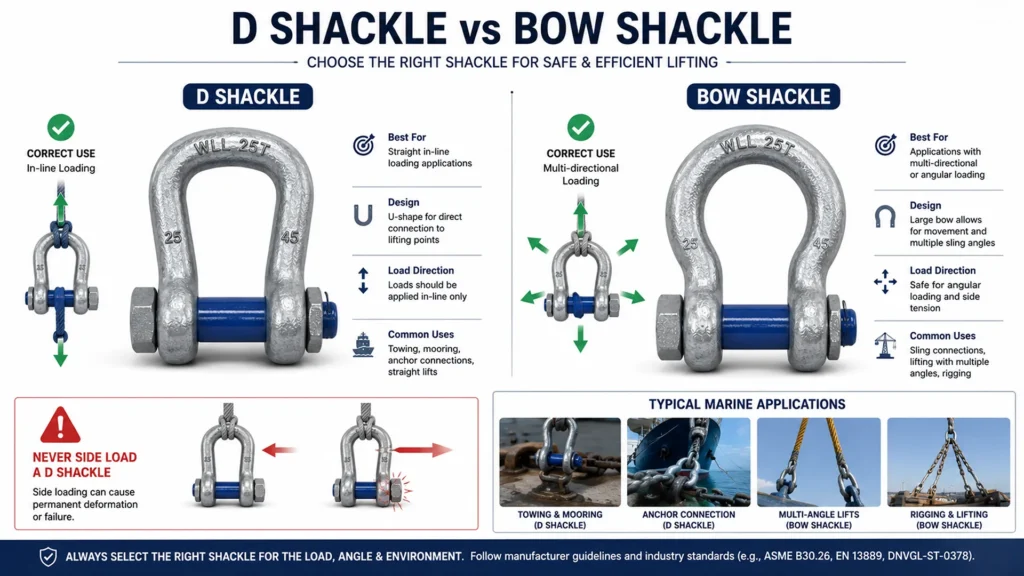
A D shackle is designed to carry force in a straight line between the pin and the body of the shackle. This is known as in-line loading, and it allows the load to be distributed evenly across the shackle.
Side loading occurs when the force pulls from an angle instead of along the shackle’s centreline. This creates uneven stress on the pin and bow, increasing the risk of bending, deformation, or failure. In shipyards, side loading can happen if mooring lines shift, lifting points are poorly aligned, or deck hardware changes direction under load.
Using a D shackle outside its intended loading direction can reduce its effectiveness and compromise safety. Proper alignment is therefore essential during lifting, towing, and mooring operations.
When to Use a D Shackle vs a Bow Shackle in Marine Settings
Choosing the correct shackle depends on the direction of the load and the application.
| Application | Recommended Shackle | Reason |
|---|---|---|
| Straight-line lifting | D Shackle | Best for in-line tension |
| Deck hardware connections | D Shackle | Compact design suits fixed connections |
| Mooring lines | Bow Shackle | Handles multiple loading angles better |
| Anchor systems | Bow Shackle | Provides extra space for chains and fittings |
| Multi-leg lifting arrangements | Bow Shackle | Better suited for varying load directions |
Although a bow shackle can accommodate limited angular loading more effectively than a D shackle, it should still be used within the manufacturer’s specified working limits.
Closure Type Selection for Shipyard Use
The pin style is just as important as the shackle shape.
- Screw pin shackles are ideal for temporary rigging, routine lifting, and jobs where equipment is assembled and dismantled frequently. They allow quick installation and removal but should be checked regularly to ensure the pin has not loosened.
- Bolt-type shackles use a bolt, nut, and securing cotter pin, making them better suited for long-term or critical installations where vibration or repeated movement could cause a screw pin to rotate loose.
Selecting both the correct shackle type and the appropriate closure helps improve safety, reliability, and compliance with safe lifting practices in shipyard operations.
What Happens When a Bulk Order Fails Inspection
When a bulk D shackle order fails inspection, the impact goes far beyond replacing a few defective parts. It can disrupt project schedules, increase costs, and create unnecessary compliance issues.
Some of the most common reasons for inspection failure include:
- Inconsistent Working Load Limit (WLL) markings across the same batch
- Missing or incomplete batch traceability records
- Poor coating quality, such as uneven galvanising, peeling finishes, or visible corrosion
- Dimensional variations that affect proper fit and performance
- Missing test certificates or incomplete inspection documentation
The consequences can be significant. A rejected shipment may delay installation, require expensive rework or replacement, and trigger additional quality audits. For industries such as marine, offshore, construction, and heavy lifting, repeated quality issues can also damage a supplier’s reputation with customers and, where applicable, classification societies that expect consistent compliance with recognised standards.
One of the simplest ways to reduce this risk is through proactive sample testing before confirming the full order. As discussed earlier in Step 4, reviewing production samples, checking documentation, and verifying dimensions and markings can help identify problems before large-scale manufacturing begins. Catching issues early is far less costly than dealing with rejected shipments after production or delivery.
How to Vet a Bulk D Shackle Supplier — A Self-Serve Framework
Selecting a bulk D shackle supplier should be based on objective evidence rather than marketing claims. A reliable supplier will be transparent about manufacturing processes, testing, and documentation, making it easier for buyers to assess product quality before placing a large order.
Questions to Ask Before Placing a Bulk Order
Start by asking practical questions that reveal how the supplier manages quality.
Some useful questions include:
- Are the shackles forged or cast?
- Which recognised standards do they comply with?
- Can you provide proof load or test certificates?
- Is batch traceability available for every shipment?
- Can production samples be supplied before mass manufacturing?
- What is the expected sample approval timeline?
- What quality checks are performed before dispatch?
Clear and detailed answers usually indicate an organised quality management process.
How to Independently Verify WLL Claims
Never rely only on the marking stamped onto the shackle.
Instead, compare the Working Load Limit (WLL) marked on the product with the supporting proof load or test documentation provided by the supplier. Check that the batch numbers, product sizes, and identification markings match across both the physical product and the certificates.
If information is inconsistent or incomplete, request clarification before approving the order.
Red Flags That Signal an Unreliable Supplier
Certain warning signs deserve extra attention during supplier evaluation.
Be cautious if a supplier:
- Refuses to provide production samples
- Makes vague claims about meeting “international standards” without supporting evidence
- Cannot explain its testing or inspection process
- Provides incomplete or inconsistent documentation
- Gives unusually long lead times without a clear production or logistics reason
- Frequently changes technical specifications during discussions
These issues may indicate weak quality control or poor production planning.
A Quick Vetting Checklist
Before confirming a bulk order, make sure you can answer yes to the following:
- ✓ Products are forged where required for the application.
- ✓ WLL markings are clear, permanent, and consistent.
- ✓ Proof load or test certificates are available.
- ✓ Batch traceability is documented.
- ✓ Production samples have been reviewed.
- ✓ Dimensions and finish meet your specifications.
- ✓ Delivery timelines are realistic and clearly explained.
- ✓ The supplier responds promptly and provides complete technical documentation.
Using this simple framework helps buyers compare suppliers objectively, reduce procurement risks, and make more informed purchasing decisions for bulk D shackle orders.
A D shackle has a narrower, straight-sided shape and is designed for in-line loads. A bow shackle has a larger, rounded bow that can accommodate multiple sling legs or wider connections. Neither should be used outside the manufacturer’s rated working load limit.
A reliable supplier should provide material test certificates, proof load test records, heat treatment details where applicable, traceability information, and relevant compliance documentation required by your project or classification society.
Minimum order quantities (MOQs) vary by manufacturer and shackle size. Standard models may have lower MOQs, while customised or special-grade shackles often require larger production runs.
Lead times depend on stock availability, order volume, product specifications, and shipping method. Standard items may ship faster, while custom orders generally require additional manufacturing time.
No. D shackles are primarily designed for straight-line loading. Side loading can significantly reduce their capacity and increase the risk of failure unless specifically approved by the manufacturer.
Conclusion
Choosing the right supplier for bulk shipyard D shackles is about more than getting a competitive price. Prioritise suppliers that offer verified compliance documentation, clear and transparent landed cost estimates, and a proven track record of serving marine and shipbuilding projects. These factors help improve safety, simplify procurement, and reduce project risk. If you’re planning a bulk purchase, request a detailed quotation, ask for the latest certification documents, or download the product specification sheet to compare options with confidence.