 trivedi associate September 26, 2026
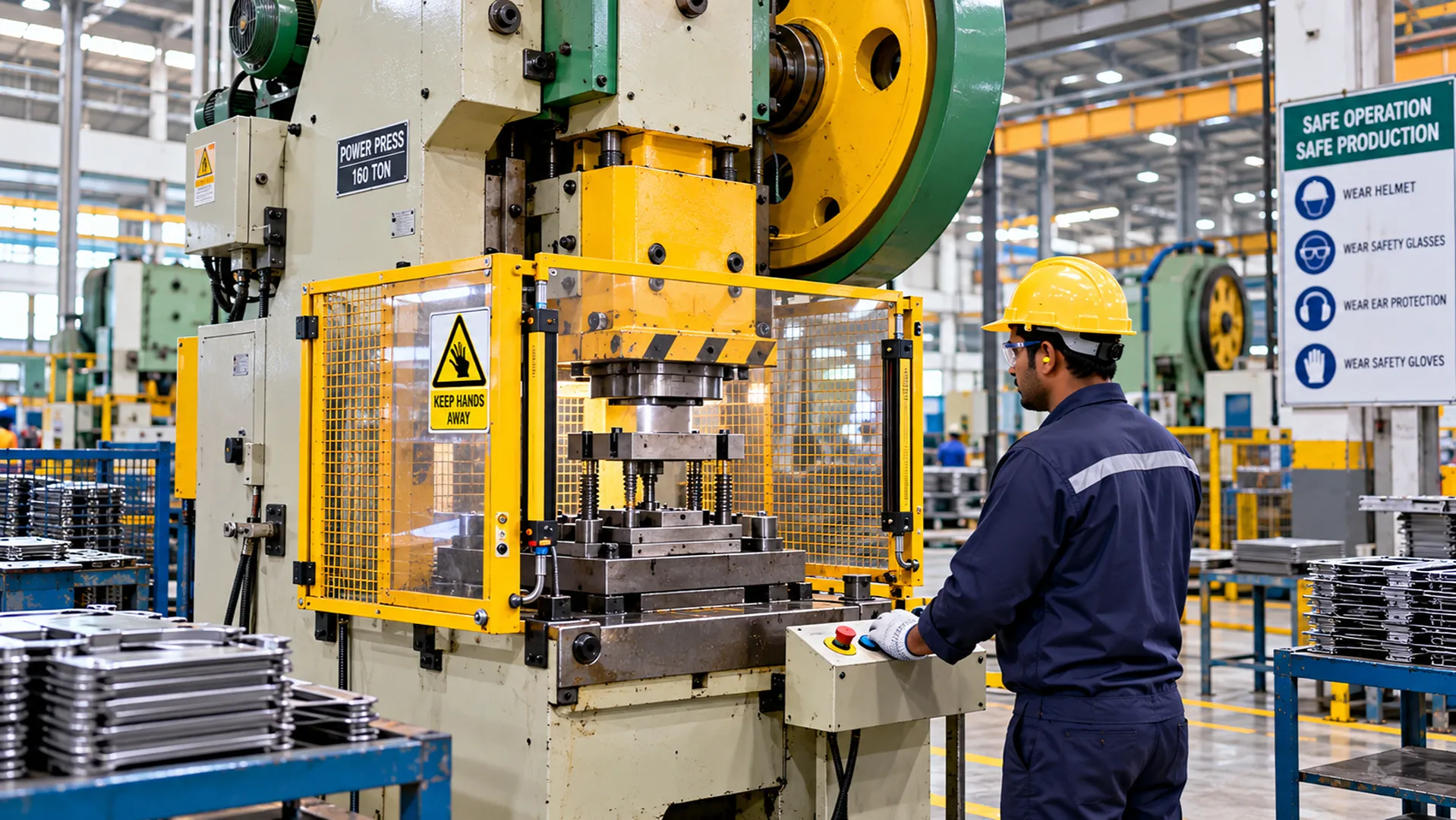
A power press machine is a mechanically or hydraulically driven piece of industrial equipment used to shear, bend, or form sheet metal using a punch and die set. In everyday shop-floor language, it’s often called a punch press. The machine works by driving a ram downward with controlled force, pressing the punch into the die to cut or shape the metal in a single, repeatable stroke. Power presses are a core part of metal stamping operations across sheet metal fabrication, automotive components, and general engineering industries, where speed and repeatability matter as much as precision.
How Does a Power Press Machine Work?
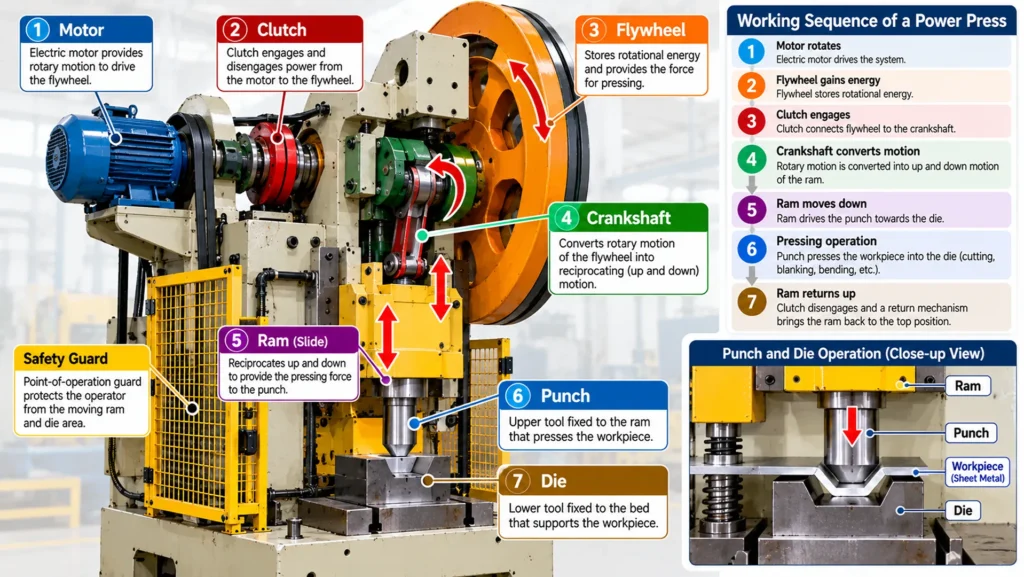
The basic working principle is straightforward once you break it down. A flywheel, driven by an electric motor, continuously stores rotational energy. When the operator triggers the machine, a clutch engages and connects the flywheel to the crankshaft. The crankshaft then converts that rotary motion into the linear up-and-down movement of the ram.
As the ram descends, it drives the punch into the die, shearing, bending, or forming the metal sheet in a fraction of a second. Once the cycle is complete, the clutch disengages and the ram returns to its top position, ready for the next stroke. It’s a simple mechanical chain, but it’s also why point-of-operation safety matters so much — a lot of force is generated in a very short window of time.
Types of Power Press Machines
Not all power presses work the same way, and the type you use depends heavily on the job at hand.
- Mechanical Power Press: Built for speed. Mechanical presses use the flywheel-crankshaft mechanism described above and are best suited to high-volume stamping operations where consistent, fast cycle times matter more than adjustable force.
- Hydraulic Power Press: Uses hydraulic cylinders instead of a mechanical crankshaft, which allows for adjustable force and stroke length. This makes hydraulic presses a better fit for deep drawing operations, where the metal needs to be gradually formed into a deeper shape without tearing.
- Pneumatic Power Press: Air-driven and generally lighter-duty. Pneumatic presses are typically used for precision work on light-gauge materials, where the force required is lower and speed still matters.
Each of these has a natural fit depending on the material, thickness, and type of operation involved — which is exactly what the next section walks through.
How to Choose the Right Power Press for Your Application
Picking the right power press isn’t just about tonnage on a spec sheet. It comes down to matching the machine to the actual operation you’re running.
Estimating Tonnage Requirement by Operation
Tonnage requirements aren’t one-size-fits-all — they change depending on whether you’re blanking, punching, bending, or deep drawing, so it’s worth treating each separately rather than reaching for a single universal formula.
For blanking and punching, tonnage is generally estimated based on the shear strength of the material, the thickness being cut, and the perimeter length of the cut. In practice, this means the formula factors in the material type (mild steel, stainless steel, aluminium, etc.), its shear strength value, sheet thickness, and the total length of the cut line, with the result expressed in tons. A thicker sheet or a higher shear-strength material will always push the required tonnage up.
For bending operations, the calculation instead depends on the bend length, material thickness, tensile strength of the material, and the die opening width (the V-die width), since bending force is closely tied to how the material spans across the die opening.
For deep drawing, tonnage estimation needs to account for the blank diameter, material thickness, tensile strength, and a friction factor between the die and the material, since deep drawing involves stretching the metal over a punch rather than shearing or bending it in place.
In all three cases, it’s worth working with your press manufacturer or a qualified die designer to confirm the exact calculation for your specific job, since assumptions around material grade and die geometry can shift the numbers meaningfully.
Matching Stroke Length to Process
Stroke length needs to match the process too. Blanking operations generally need a short, fast stroke since the material only needs to be cut through. Deep drawing needs a longer stroke to allow the punch to travel far enough to form the part fully. High-speed stamping, on the other hand, prioritises a short stroke that can be repeated very quickly, since cycle time is the priority there.
Budget vs. Maintenance Trade-offs
There’s also a straightforward budget-versus-maintenance trade-off between mechanical and hydraulic presses. Mechanical presses tend to have a lower upfront cost but experience more wear on components like the clutch and brake over time, especially under high-volume use. Hydraulic presses usually cost more to buy initially, but offer more control over force and stroke, which can reduce strain on tooling and, in some applications, lower long-term maintenance demands. The right choice really depends on your production volume, the type of parts you’re making, and how much flexibility you need from the machine.
Power Press Safety & Compliance in India
Power presses fall under specific statutory safety requirements in India, and Gujarat manufacturers need to be familiar with both the central law and the state-specific rules that apply.
Factories Act, 1948
The Factories Act, 1948 sets out the overarching safety framework for factories in India, and two provisions are particularly relevant to power presses. Section 21 deals with the fencing of machinery, requiring that dangerous parts of machinery — which would include the point-of-operation area on a power press
Be securely fenced. Section 87 empowers state governments to notify certain manufacturing processes or operations as dangerous, allowing additional rules to be framed for them, and power press operations have historically been treated as falling within this category in several states. Because the exact wording and applicability can be amended over time, it’s worth confirming the current text of these sections against the latest bare act before publishing anything that cites them directly.
Gujarat Factories Rules, 1963 — Schedule VI (Power Press)
Gujarat has its own specific rules for power presses under the Gujarat Factories Rules, 1963, laid out in Schedule VI. Broadly, these rules cover several areas that plant owners and safety officers need to be aware of:
- Requirements around the starting and stopping mechanism of the press, including a dedicated safety stop
- Fixed-guard requirements and protection for the tool and die area
- Appointment of a competent person responsible for setting or adjusting tools and safety devices
- Periodic examination and testing of the press itself, along with its safety devices
- Training and instruction requirements for operators before they’re allowed to run the machine
Because Schedule VI is periodically amended, the exact clause numbers and current requirements should be checked against the latest published rules before relying on them for compliance decisions.
Machine Guarding, Interlocks & Safety Devices — Applicable Requirements and Good Engineering Practice
Guarding is where a lot of the real safety work happens on a power press. Schedule VI permits different approaches depending on the machine and operation — fixed guards, interlocked or automatic guards, and presence-sensing safety devices are all recognised as valid options in different contexts. It’s important to be clear that not every one of these is mandatory for every machine or operation; what’s statutorily required can depend on the specific press type, the operation being performed, and how the die is set up.
Beyond the strict statutory minimum, many of these guarding practices are also simply good engineering practice, adopted because they reduce risk even where they aren’t explicitly mandated. Plant safety officers should treat this as a case-by-case assessment rather than assuming one guarding method applies universally.
Why Power Presses Are High-Risk Machines (And How Accidents Happen)
The main hazard on a power press comes down to a simple fact: the point of operation — where the punch meets the die — is exactly where an operator’s hands often need to be to load or position material. If the ram cycles while a hand is still in that zone, the result is a serious entrapment injury, typically to the fingers or hand. This is why the stroke cycle itself is the focus of so much safety engineering on these machines.
The combination of guarding, interlocks, and proper operator training is what reduces this risk in practice. Guards and interlocks physically prevent the ram from cycling while the danger zone is exposed or accessible, while training ensures operators understand safe loading procedures and don’t attempt to bypass safety devices to speed up production. This is exactly why the compliance requirements covered above — competent person appointments, periodic testing, and documented training — aren’t just paperwork exercises. They’re directly tied to preventing the specific way accidents happen on these machines.
Power Press Maintenance & Inspection Checklist
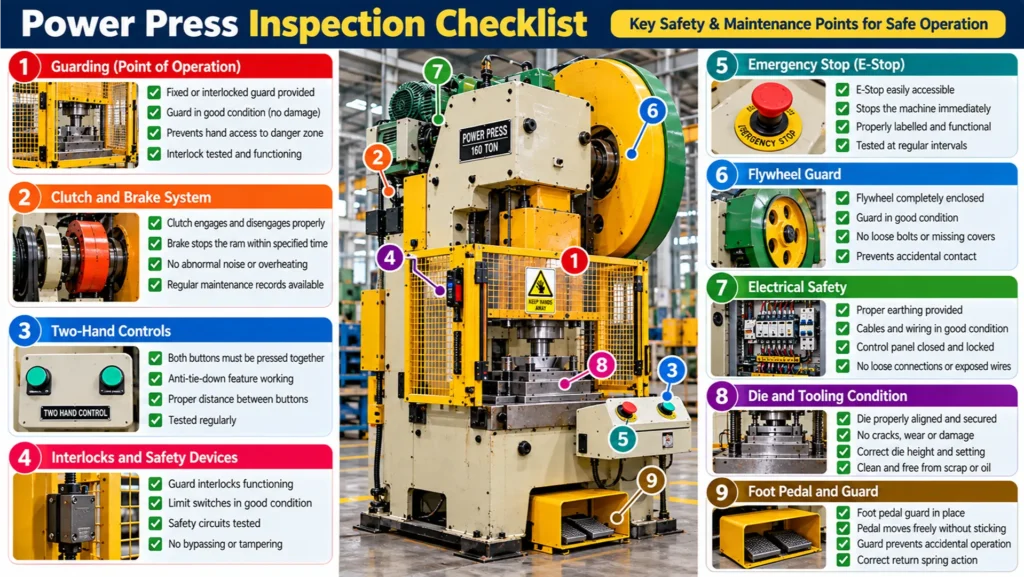
Regular inspection and a well-structured AMC (Annual Maintenance Contract) are what keep a power press both safe and productive over its working life.
Practical Inspection Points
A thorough inspection routine typically covers:
- Point-of-operation guarding — condition and correct positioning
- Clutch and brake condition — wear, response time, and engagement
- Two-hand control systems, where applicable, to confirm both controls are functioning and can’t be bypassed
- Interlocks — confirming they actually stop the ram when triggered
- Emergency stop functionality
- Flywheel and drive guarding
- Electrical safety — wiring, control panel condition, and earthing
- Die and tool condition — wear, alignment, and mounting security
- Safe operating controls generally, including any pedal guards or control-related safety features
What a Power Press AMC Should Cover
A good AMC for a power press should be built around more than just breakdown response. Inspection frequency should be set against whatever statutory schedule applies to the machine, or against the manufacturer’s recommended maintenance intervals — there isn’t a single universal frequency that applies to every press, so this needs to be confirmed for the specific machine and its usage pattern. Beyond inspection scheduling, a solid AMC should also include ready access to spare parts, a defined breakdown response time, and proper compliance documentation so that inspection and maintenance records are available whenever they’re needed for audits or statutory checks.
Power Press Machine Cost & Total Cost of Ownership
Power press pricing varies significantly by tonnage and type, and mechanical presses generally sit at a lower upfront price point than hydraulic presses of comparable capacity, reflecting the mechanical simplicity of the drive system. That said, the purchase price is only part of the picture. Ongoing costs include power consumption — which can differ meaningfully between mechanical and hydraulic systems depending on how the machine is used — along with tooling and die costs, which tend to be a recurring expense as dies wear or need replacement for new part designs.
AMC and maintenance spend is the other major ongoing cost driver, and as covered above, this should be planned around the machine’s actual usage and statutory inspection requirements rather than treated as an afterthought. Looking at total cost of ownership rather than just the sticker price gives a more realistic picture of what a power press will actually cost to run over its working life.
FAQs
Factories operating power presses are generally required to register and comply with the Factories Act, 1948, along with applicable state-specific rules like Gujarat’s Schedule VI. Specific registration requirements should be confirmed with the local factory inspectorate, as they can depend on factors like the number of workers and whether power is used in the manufacturing process.
In practice, the terms are largely used interchangeably. “Punch press” is a common alternate name for the same category of machine — one that uses a punch and die to shear, bend, or form metal.
Inspection frequency should follow the applicable statutory schedule for the machine, or the manufacturer’s recommended maintenance interval where no specific statutory frequency is set. This can vary depending on the machine type and how intensively it’s used.
Mechanical presses typically have a lower upfront cost and are well suited to high-volume, fast-cycle work, while hydraulic presses cost more initially but offer more control over force and stroke. Which one is cheaper to run overall depends on your specific application, usage pattern, and maintenance needs rather than a flat comparison.