 trivedi associate September 26, 2026
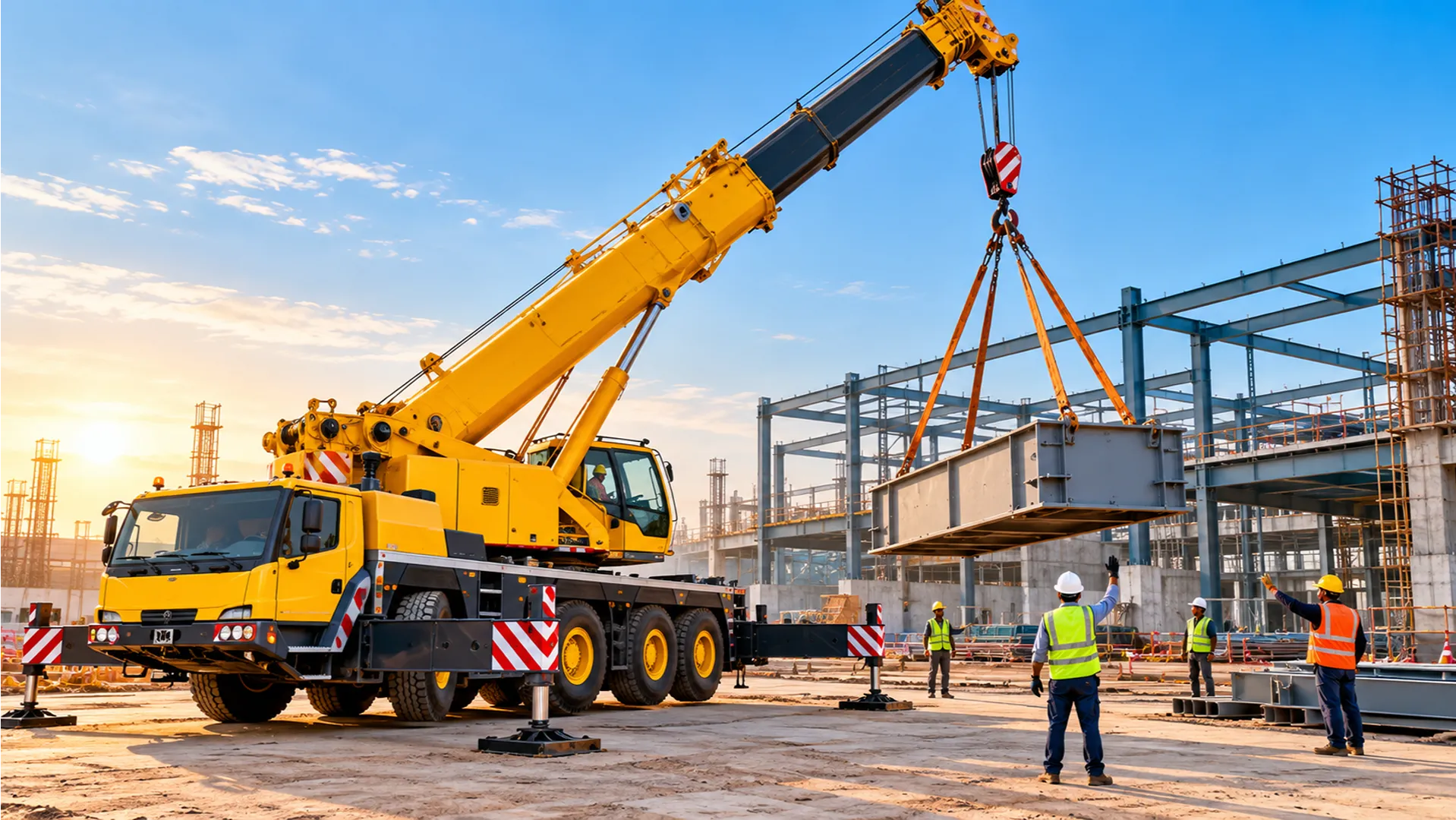
A mobile crane is a crane mounted on wheels or tracks that can move under its own power from one location to another, without needing to be dismantled and rebuilt at every site. That mobility is what sets it apart from static or tower cranes, and it’s also what makes selecting the right one more complicated than it looks.
Most guides on this topic stop at listing crane types. This one goes further. Here, you’ll get a practical framework for actually choosing the right crane for your project, understanding how rated capacity works for your specific lift, and figuring out which statutory requirements genuinely apply to your site in Gujarat — instead of a generic rulebook that treats every mobile crane the same way.
What Is a Mobile Crane?
A mobile crane is a self-propelled lifting machine that combines a boom, hoisting mechanism, and undercarriage into one unit capable of traveling to a job site on roads or rough terrain. Unlike static cranes, which are fixed in one position for the duration of a project, or tower cranes, which are erected and remain stationary at height, a mobile crane can be driven or transported in, set up, used for the lift, and moved on. This mobility is the defining feature — it’s what makes mobile cranes the go-to choice for projects where the lifting need is temporary, the site changes, or multiple locations need coverage from the same machine.
Types of Mobile Cranes
Different mobile crane types are built for different ground conditions and lift requirements. Here’s a quick comparison:
| Crane Type | Typical Use Case | Terrain Suitability |
| Crawler Cranes | Heavy lifts on large industrial or infrastructure sites | Soft, uneven, or unprepared ground; moves on tracks |
| Truck-Mounted Cranes | Quick mobilization between sites on public roads | Paved roads and firm, prepared ground |
| Rough-Terrain Cranes | On-site lifting in construction and industrial yards | Rough, uneven, off-road terrain |
| All-Terrain Cranes | Projects needing both highway travel and off-road lifting | Both paved roads and rough terrain |
| Carry Deck Cranes | Compact lifts in tight or congested spaces | Indoor or confined worksites, flat ground |
Each of these trades off differently between mobility, capacity, and terrain flexibility, which is exactly why the “right” type depends on your specific project conditions — covered next.
How to Choose the Right Mobile Crane for Your Project
Picking a mobile crane isn’t just about tonnage. It comes down to matching the crane’s capabilities to your actual site conditions and lift requirements. Here’s the decision framework worth working through before you finalize anything:
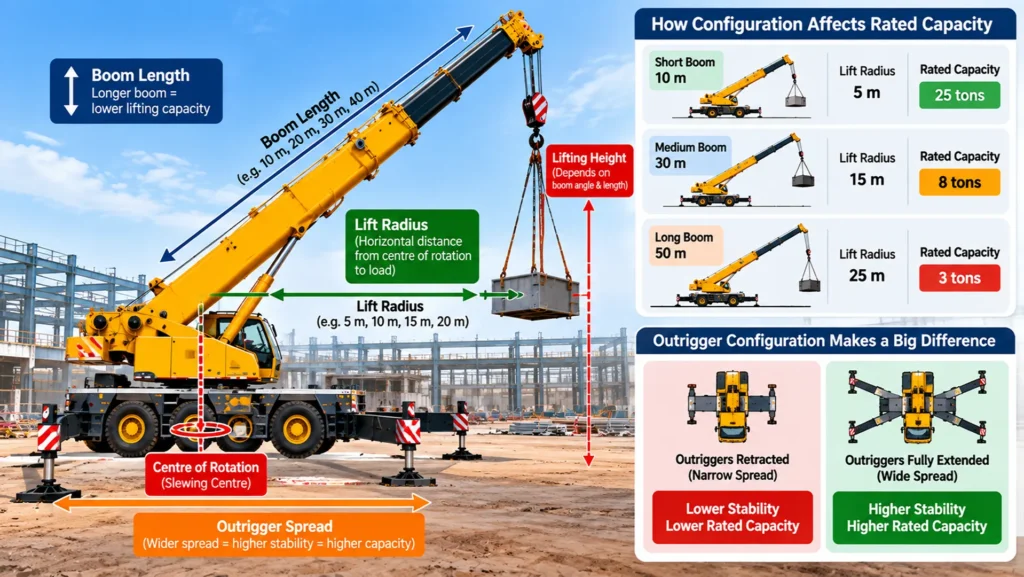
Load weight and lift radius. This is your starting input, not a standalone number. The weight you need to lift and how far out (radius) you need to lift it together determine which crane — and which configuration of that crane — can actually do the job. This figure only becomes meaningful once it’s checked against the crane’s load chart for that specific radius and boom setup (more on this in the compliance section below).
Site access and terrain. Is the site on paved, level ground, rough and uneven terrain, or a congested urban space with limited maneuvering room? A truck-mounted crane makes sense on accessible paved sites; a rough-terrain or crawler crane is better suited to uneven industrial or construction ground; a carry deck crane fits tight, confined spaces where a larger unit simply won’t fit.
Ground bearing pressure and outrigger setup. The ground under and around the crane needs to bear the combined weight of the machine, the load, and the outrigger reaction forces. Soft or uncompacted soil may need outrigger mats or pads, or may rule out certain crane classes altogether.
Boom height and reach. Match the boom length and configuration — including any jib or extension — to the actual height and horizontal reach the lift demands, not just the maximum the crane can theoretically achieve.
Rental duration versus project timeline. A short, one-off lift and a multi-week project have very different economics and mobilization considerations. Factor in how long you’ll actually need the crane on-site against your project schedule.
A simple way to think about it:
| Project Condition | Recommended Crane Type |
| Paved site, easy road access, quick mobilization | Truck-mounted crane |
| Rough or uneven ground, construction site | Rough-terrain crane |
| Mix of highway travel and off-road lifting | All-terrain crane |
| Heavy lift, soft or unprepared ground | Crawler crane |
| Congested or indoor space, compact lift | Carry deck crane |
Getting this selection right at the planning stage avoids the bigger headache of discovering mid-project that your crane can’t safely make the lift at the radius or ground conditions you actually have.
Mobile Crane Safety & Compliance in India
Safety and compliance is where mobile crane operations in India get genuinely complicated — and where a lot of the information available online tends to oversimplify.
Applicable Statutory Requirements for Mobile Cranes in India/Gujarat
One of the most common misunderstandings about mobile crane compliance in India is assuming there’s a single, uniform rulebook that applies everywhere. There isn’t. The regulatory framework that governs your crane depends on where and how it’s being used:
- For mobile cranes used on general construction or industrial sites, the relevant provisions typically fall under the Factories Act and the corresponding state factory rules, the Building & Other Construction Workers (BOCW) Act and Regulations, along with applicable lifting-equipment standards, including relevant IS (Indian Standard) specifications.
- DGMS (Directorate General of Mines Safety) regulations apply only where the crane is being used within a mine or a mining lease area regulated by DGMS. DGMS is not a universal requirement for every mobile crane in the country — it’s specific to mining operations.
If you’re a site engineer or contractor in Gujarat, the first step isn’t compliance documentation — it’s correctly identifying which regulatory authority and Act actually governs your specific site and how the crane is being used there. Once that’s established, you document compliance against that framework specifically, rather than applying a generic checklist. Given how site-specific this determination can be, it’s worth verifying the current applicable Act and Rules for your situation before finalizing any compliance documentation.
Load Testing & Third-Party Inspection Cycles
Load testing and third-party inspection exist to confirm that a crane can safely handle the loads it’s rated for, and that its structural and mechanical components haven’t degraded to the point of being unsafe. Inspection typically covers structural components, wire ropes, hooks, safety devices, and the crane’s overall mechanical condition, and it needs to be carried out by an authorized, competent person, with proper documentation maintained and available on-site.
What we won’t do here is quote a specific inspection or load-testing frequency — whether that’s every six months, annually, or any other interval — without confirming it against the exact statutory provision or standard it comes from, whether that’s the Factories Act Rules, BOCW Regulations, the relevant IS standard, or DGMS Regulations where mining use applies. The safest approach for now is to plan inspections at the intervals defined by whichever statutory framework applies to your site, and confirm the exact figure with the relevant authority or a qualified compliance professional before you finalize a schedule.
Load Chart, Crane Configuration & Rated Capacity Verification Before the Lift
Here’s something worth repeating because it trips up a lot of site teams: a mobile crane does not have one fixed safe working load. Its rated capacity changes depending on the exact configuration it’s in at the time of the lift.
The rated capacity for any given lift is read from the manufacturer’s load chart for that crane, and it depends on several factors together, not any one of them in isolation:
- Lift radius — how far out the load is from the crane’s center of rotation
- Boom length and configuration, including whether a jib or extension is fitted
- Outrigger configuration and extension — fully extended versus partially extended, and whether the crane is operating on outriggers or on tyres
- Other applicable parameters, such as the counterweight fitted, whether the lift is over-front, over-side, or over-rear, and the number of falls of rope in use
This is why load chart verification has to happen before every lift, not as a paperwork formality but as a genuine safety check. If you see a capacity figure quoted anywhere for a mobile crane — including elsewhere in this article — treat it as meaningful only when it’s tied to the manufacturer’s load chart for a specific, stated configuration. A generic “this crane can lift X tonnes” claim, without the radius and configuration attached, isn’t something you can safely act on.
Practical Pre-Lift & Site Safety Considerations
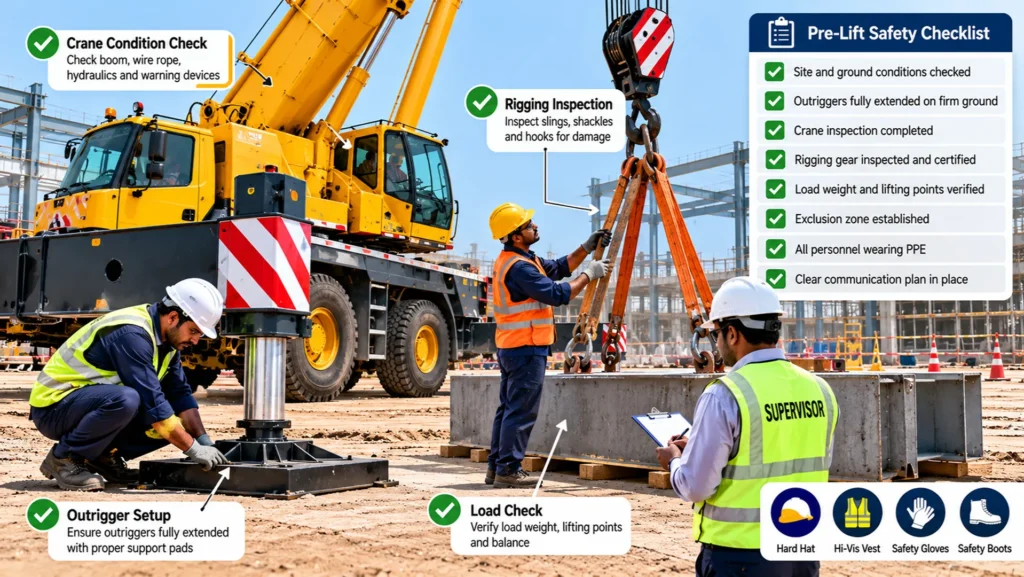
Beyond the statutory framework, there’s a set of practical checks that make the real difference between a safe lift and an incident. These are the details that separate genuinely useful compliance guidance from a generic checklist:
- Ground bearing capacity at the exact footprint where the crane and outriggers will sit
- Outrigger support — mats or pads sized correctly for the ground conditions and the load being imposed
- Crane levelling completed and verified before any lift begins
- Lift radius verification against the load chart for the specific planned lift, not an assumed or estimated radius
- Clearance from overhead electrical lines, maintaining safe working distances at all times
- Environmental and wind limits as specified by the OEM for that particular crane model
- Operator competency — valid licensing or certification, and familiarity with the specific crane being operated
- Rigging arrangement — correct sling selection, sling angles, and awareness of the load’s centre of gravity
- Lift planning — a documented method statement or lift plan, particularly important for critical or non-routine lifts
None of these steps are optional extras. They’re the difference between a lift that goes according to plan and one that doesn’t.
Mobile Crane vs. Tower Crane vs. Static Crane
Each crane type serves a different kind of project, and the right choice usually comes down to mobility needs, height requirements, and how long the crane needs to stay in one place.
| Factor | Mobile Crane | Tower Crane | Static Crane |
| Mobility | High — self-propelled, moves between sites | None — fixed once erected | None — fixed for project duration |
| Setup time | Relatively fast | Longer — requires erection and dismantling | Moderate, depends on type |
| Max height | Limited by boom length | Very high — suited to tall building construction | Varies by design |
| Cost | Often lower for short-duration or single-site use | Higher setup cost, economical for long, tall projects | Depends on scale and duration |
| Best-use case | Short-term, multi-location, or variable-radius lifts | Tall building construction with sustained lifting needs | Long-duration lifts at a fixed location |
Choose mobile if your project needs flexibility and the lift is short-term or spread across locations. Choose tower if you’re building tall and need sustained lifting capacity at height over a long project. Choose static if your lift is long-duration but doesn’t need the height a tower crane offers.
Cost of Operating a Mobile Crane: Rental vs. Ownership
The rent-versus-own decision usually comes down to how often you actually need a crane, not just the sticker price of either option.
Rental cost drivers typically include the crane’s capacity class, how long you need it for, and the mobilization distance — moving a large crane a long way adds cost before it even starts lifting.
Ownership costs bring their own considerations, particularly Annual Maintenance Contract (AMC) costs to keep the crane in safe, compliant working condition over its lifetime.
Fuel and operating costs also vary by crane type and size — larger, heavier cranes generally cost more to run per hour than smaller units.
Rates for both rental and ownership vary significantly by region and vendor, so it’s worth treating these as cost factors to weigh rather than expecting fixed pricing. As a general rule, renting tends to make more financial sense if your need for a mobile crane is occasional or project-specific; ownership starts to pay off once your lifting needs are frequent enough to justify the ongoing maintenance and capital cost.
A Typical Mobile Crane Lift: Site Prep to Demobilization
Here’s what a mobile crane lift generally looks like from start to finish:
- Site survey and ground assessment — checking ground bearing capacity, and identifying overhead lines or obstructions before the crane arrives.
- Crane positioning, levelling, and outrigger setup — getting the crane into position and properly stabilized before any lifting begins.
- Lift planning and load chart verification — confirming rated capacity for the exact configuration that will be used for this specific lift.
- Rigging arrangement and the lift itself — securing the load correctly and carrying out the lift according to plan.
- Post-lift inspection and demobilization — checking the crane and rigging after the lift, then safely breaking down and moving out.
This sequence isn’t just procedure for its own sake — every step ties directly back to the selection and compliance considerations covered earlier in this guide.
Frequently Asked Questions
What is the maximum load a mobile crane can lift?
There’s no single maximum figure for a mobile crane. Its lifting capacity is set by the manufacturer’s load chart for the specific configuration in use at the time — including boom length, lift radius, and outrigger setup — not one fixed number that applies regardless of how the crane is set up.
What inspection and certification requirements apply to mobile cranes in India?
The applicable framework depends on where the crane is used. On general construction or industrial worksites, requirements typically fall under the Factories Act, state factory rules, and BOCW Regulations. DGMS regulations apply specifically where the crane operates within a mine or mining lease area.
How often should a mobile crane be inspected?
Inspection frequency should be confirmed against the applicable statutory provision or standard for your specific site — whether that’s Factories Act Rules, BOCW Regulations, or another relevant framework — rather than assuming a single fixed interval applies universally.
Is renting or owning a mobile crane cheaper for small contractors?
For small contractors with occasional lifting needs, renting is usually more cost-effective since it avoids ongoing maintenance and capital costs. Ownership tends to make more financial sense once lifting needs become frequent enough to offset AMC and operating costs over time.
For more on getting this right in practice, see our related guides on AMC for lifting equipment, load testing and certification, load chart and rated capacity verification, chain pulley block inspection, applicable statutory compliance for lifting equipment, and electric wire rope hoist installation.