 trivedi associate September 9, 2026
If you’re a mine safety officer, a contractor handling lifting gear on a mine site, or someone in procurement sourcing this kind of equipment, you probably already sense that lifting gear on a mine doesn’t play by the same rules as lifting gear in a regular factory. That’s really what DGMS lifting equipment inspection requirements come down to — a separate, stricter set of expectations built around how mines actually operate.
This guide covers what falls under DGMS’s watch, how inspection and testing usually work, who’s allowed to sign off on equipment, and what happens when compliance gets treated as paperwork rather than practice. It’s not a supplier directory or a sales pitch. It’s meant to help you know what to ask for and what to check before any of this gear goes into service.
Understanding DGMS Lifting Equipment Inspection Requirements

DGMS — the Directorate General of Mines Safety — is the central body responsible for occupational safety, health, and welfare across India’s coal, metalliferous, and oil mines. It sits under the Ministry of Labour & Employment and administers the Mines Act, 1952, plus the various Regulations, Rules, and Bye-laws that fall under it. DGMS lifting equipment inspection requirements live inside this wider framework, and they’re specific to equipment used at mine sites — not a general industrial standard that applies everywhere.
Mines involve a lot of heavy lifting, literally. Ore, machinery, people moving through shafts, materials being shifted underground and on the surface — all of it depends on equipment that has to hold up under real, repeated strain. That’s part of why winches, hoists, chain pulley blocks, wire rope slings, chain slings, and shackles used in mining tend to face a tighter inspection and approval regime than similar gear used in a general factory.
Note: the exact statutory provisions under the Mines Act and the applicable Regulations (Coal Mines Regulations, Metalliferous Mines Regulations, or Oil Mines Regulations, depending on the site) should be confirmed against the current, in-force text before this section is finalized — regulation numbering and specifics can shift depending on the type of mine.
Inspection & Testing Requirements for Lifting Equipment in Mines

Meeting DGMS lifting equipment inspection requirements isn’t a one-time check. Equipment on a mine site typically passes through several layers of scrutiny — starting with the person using it that day and going all the way up to formal periodic examinations.
Periodic Thorough Examination Requirements
Mining regulations generally require lifting machinery and lifting gear to go through a periodic “thorough examination,” carried out by someone recognized as competent to do it — separate from the everyday checks an operator runs before use. The point of this is to catch problems that a quick glance wouldn’t reveal: wear that’s building up slowly, damage that isn’t obvious yet. We haven’t stated a fixed interval here on purpose — the exact frequency and the specific regulation it falls under needs to be confirmed and cited before this goes live. This is a safety-critical detail, and it’s not one we want to get wrong just to fill in a number.
Testing After Repair or Alteration
Any time lifting equipment gets repaired, modified, or has a load-bearing part swapped out, it should be re-tested and re-certified before going back into use. That’s more or less standard expectation under mining safety practice. A shackle with a weld repair, a wire rope sling that’s been re-terminated, a winch drum that’s been rebuilt — none of these should just get a visual once-over and be sent back out. This is honestly one of the more common gaps that shows up during site inspections: people treat a repaired item like it’s still the original tested item, when it isn’t anymore.
Documentation & Certification Expected on a Mine Site
At minimum, a mine site should be able to hand over the following on request:
- A test or load certificate for each item, showing SWL (safe working load), the standard it was tested against, and the test date
- A unique ID marking on the equipment that ties back to its certificate
- Records of periodic thorough examinations — not just the original test certificate from years ago
- Records of any repair, alteration, or re-certification
- A register or safety file that’s actually kept up to date, not pieced together after someone asks for it
Inspectors and auditors generally want to see the paperwork match the physical equipment in front of them. A file full of certificates means little if nobody can tell which certificate belongs to which item.
Who Can Inspect and Certify Lifting Equipment for Mine Use?
This is one area where mine-site compliance really pulls away from a standard factory setup — and it matters for understanding DGMS lifting equipment inspection requirements in practice, not just on paper.
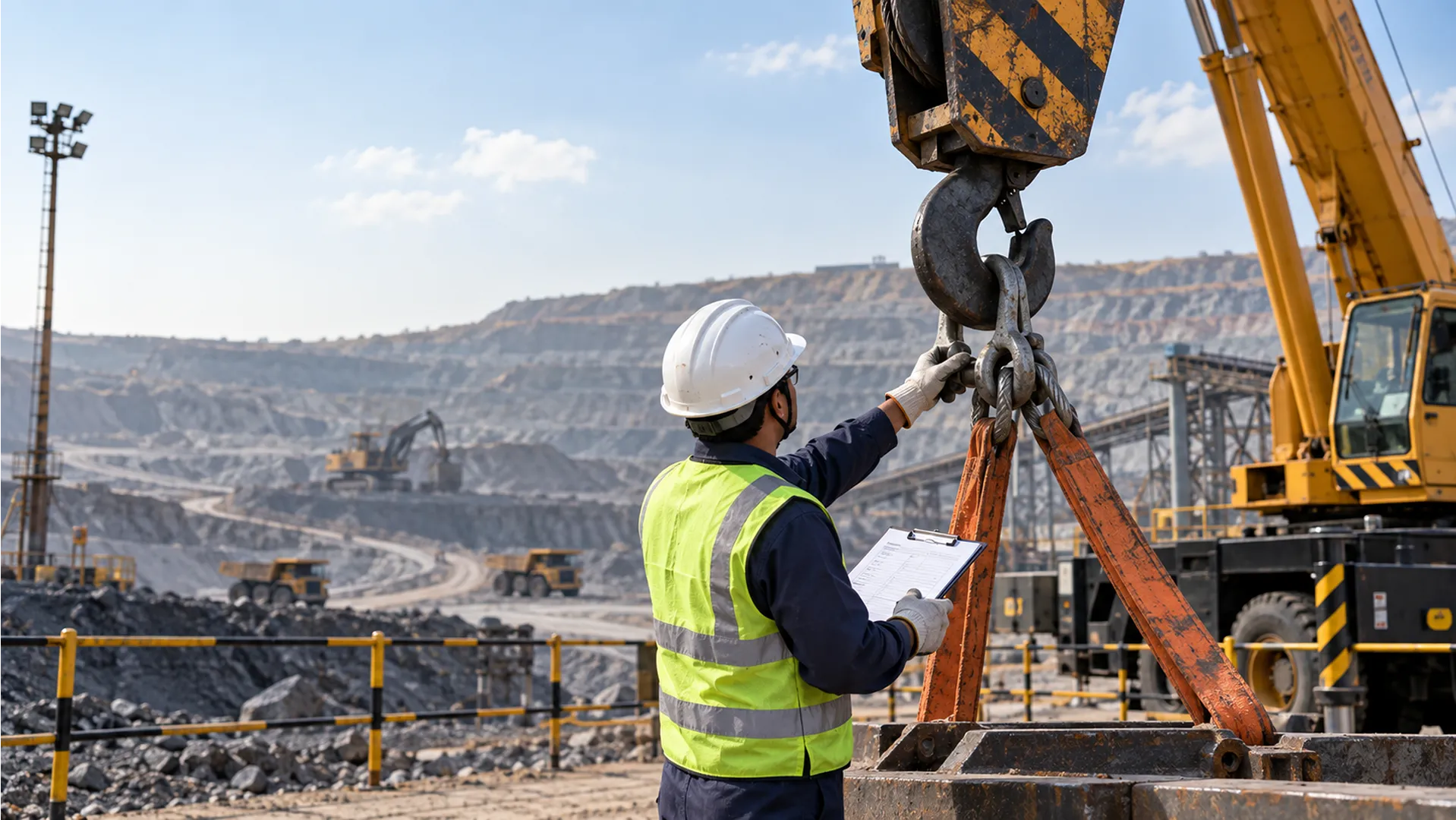
Mining regulations generally place inspection and certification duties with a Competent Person — someone formally recognized, through training, experience, and often a specific appointment, as fit to carry out thorough examinations and sign off on lifting equipment at that mine. It’s not an informal title. It’s a defined role with accountability attached to it, and the mine manager usually carries responsibility for making sure a suitably competent person is appointed in the first place.
That’s a different role from the Competent Person under the Gujarat Factory Rules, which sit under the Factories Act and apply to regular factory premises, not mines. Someone recognized as competent for a manufacturing unit under state factory rules isn’t automatically qualified to sign off on mine-site lifting equipment — and it doesn’t work the other way round either. The appointment, the scope of authority, and the regulatory basis are all different. If your business runs both a factory and a mine site, don’t assume one appointment covers both. Check what each role is actually authorized to certify.
DGMS Approval by Equipment Type — Compliance Requirements to Know

Different categories of lifting gear come with their own things to watch for. Below is a quick rundown by equipment type, focused on what compliance actually requires — not a claim about which specific approvals anyone holds.
Chain Pulley Blocks
Make sure the SWL is clearly marked, the hook has a working safety latch, and the chain doesn’t show elongation, twisting, or link damage. Like any other lifting appliance, these are due for periodic thorough examination.
Wire Rope Hoists
Check the wire rope for broken strands, corrosion, or kinking, along with brake function and wear on the drum and sheave. If a load-bearing part gets replaced, that should trigger re-testing before the hoist goes back into use.
Shackles
The SWL stamp needs to be legible, the pin has to be the correct matched pin for that shackle (not something swapped in as a substitute), and there shouldn’t be any visible deformation or cracking at the bow.
Winches
Mechanical condition matters, but winches used to move people or materials through shafts or inclines usually need closer attention paid to braking systems and anchor points — the stakes are simply higher if something fails there.
Chain Slings & Wire Rope Slings
These need periodic thorough examination along with clear SWL tagging for however they’re rigged — single-leg, multi-leg, choke hitch, and so on — since SWL changes depending on the configuration being used.
If our company genuinely holds a current DGMS or BIS approval or certification for any specific product in these categories, that needs to be confirmed and stated accurately here. Everything above is general compliance guidance, not an approval claim.
DGMS vs DGFASLI vs BIS vs PESO — Which Applies to Your Site?
These four get mixed up constantly, so here’s a quick reference. This table should go through technical review before publishing — applicability between these bodies is one of the things that gets misstated online more often than it should.
| Body | What it covers | Relevant for lifting equipment? |
|---|---|---|
| DGMS (Directorate General of Mines Safety) | Occupational safety in coal, metalliferous, and oil mines, under the Mines Act, 1952 | Yes — governs lifting equipment used at mine sites specifically |
| DGFASLI (Directorate General Factory Advice Service & Labour Institutes) | Coordinates factory inspection services and advisory work under the Factories Act, across states | Generally relevant to factory premises, not mine sites |
| BIS (Bureau of Indian Standards) | National standards body — publishes the IS standards that define how equipment should be manufactured and tested | Yes, but as a standards/conformity layer, not an operating approval |
| PESO (Petroleum & Explosives Safety Organisation) | Regulates explosives, petroleum, and pressure vessels | Only relevant if lifting operations intersect with explosives or pressure-vessel handling on site |
Worth stressing here: BIS conformity to a relevant Indian Standard often gets referenced or required within DGMS lifting equipment inspection requirements as a supporting document. It’s a piece that sits inside the DGMS process, not something that replaces it. Equipment carrying a BIS mark isn’t automatically DGMS-compliant for mine use just because of that mark.
Consequences of Non-Compliant Lifting Equipment on a Mine Site
Regulatory Exposure Under Applicable Mines Act Provisions
Running uncertified or improperly inspected lifting equipment on a mine site can expose the mine owner, manager, and contractor to regulatory action under the Mines Act and its Regulations. And if there’s ever an accident, the absence of valid test certificates or examination records tends to become the central issue in whatever inquiry follows.
Insurance Claim Risk After an Incident
When insurers review a claim after a lifting-equipment failure, the maintenance and inspection history is usually the first thing they ask for. Gaps in certification, or evidence that equipment was used past its due examination date, can complicate a claim or reduce what gets paid out — on top of whatever legal and safety consequences already come with it.
Failed Inspections and Operational Shutdowns
If a DGMS inspection turns up uncertified or overdue lifting equipment, that equipment — or sometimes that whole part of the operation — can be halted until things are brought back into compliance. For a contractor, that’s not just downtime. It’s reputational damage with the mine operator who brought you on in the first place.
FAQs
It means the equipment, and how it’s used on site, meets the requirements laid out under the Mines Act and applicable Regulations — proper testing, documentation, and periodic examination by a recognized competent person. Meeting DGMS lifting equipment inspection requirements is something you maintain, not something you finish.
How is inspection different for mine-site equipment vs. factory equipment?
Mine-site lifting equipment is inspected and certified under mining-specific regulations, by a competent person recognized under that framework — not under the Factories Act or state factory rules. The appointing authority, the scope, and the regulatory basis are all different, even when the physical equipment looks the same.
Not necessarily. BIS certification tells you the equipment meets a manufacturing or quality standard, but mine-site use typically still requires that same equipment to go through the testing, certification, and periodic examination process specific to mining regulations.
Check that the certificate references the equipment’s unique ID marking, states the SWL and the standard it was tested against, carries the signature of a recognized competent person, and that the next due examination date hasn’t already passed. Then physically cross-check the marking on the item itself against what’s on the paper.
Get Your Lifting Equipment Inspection-Ready
If you’re sourcing, operating, or managing lifting equipment on a mine site and want a second set of eyes on your inspection and certification records before an audit finds the gaps first, we’re glad to help.
We’ll review your documentation against current DGMS lifting equipment inspection requirements and point out what’s missing before it turns into a problem. Reach out for a consultation on inspection and compliance documentation for your mine-site lifting equipment.