 trivedi associate July 18, 2026
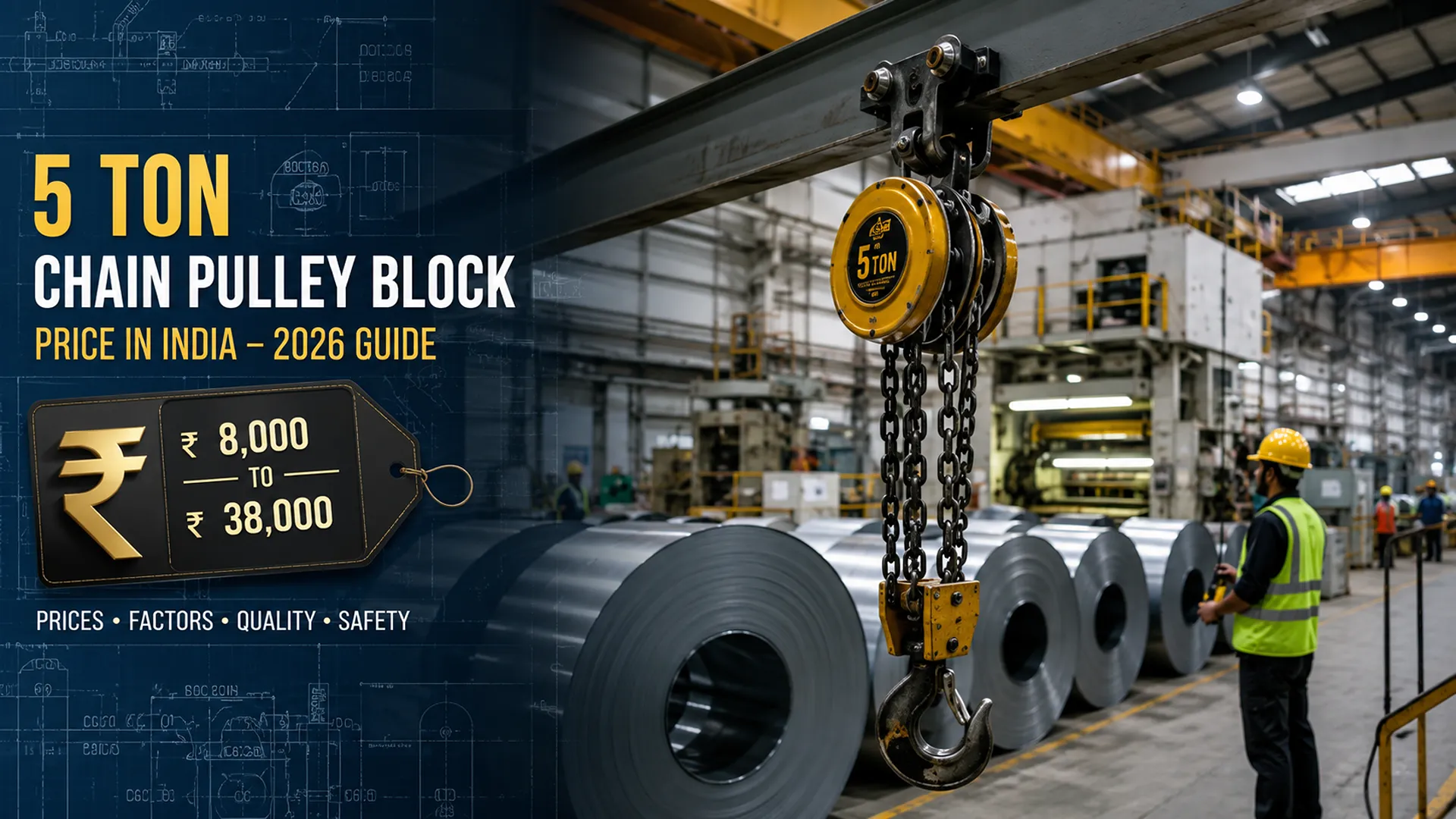
Finding a 5 ton chain pulley block price online can be confusing. One supplier may list a model for around ₹8,000, while another quotes ₹38,000 or more for what appears to be the same lifting capacity. At first glance, it can seem like one seller is overpriced. In reality, these products are often built to very different standards.
The price of a 5-ton chain pulley block depends on much more than its lifting capacity. Factors such as the grade of the load chain, manual or geared operation, manufacturing quality, certifications, brand reputation, and even the required lifting height all influence the final cost. A block designed for occasional workshop use is very different from one intended for daily operation in demanding industrial environments.
This guide explains what you can realistically expect to pay in India, what features increase the price, and how to compare different models fairly. By the end, you’ll know how to choose a chain pulley block that matches your application, budget, and safety requirements without paying for features you don’t need—or risking reliability by buying the cheapest option.
5 Ton Chain Pulley Block Price Range in India (Quick Table)
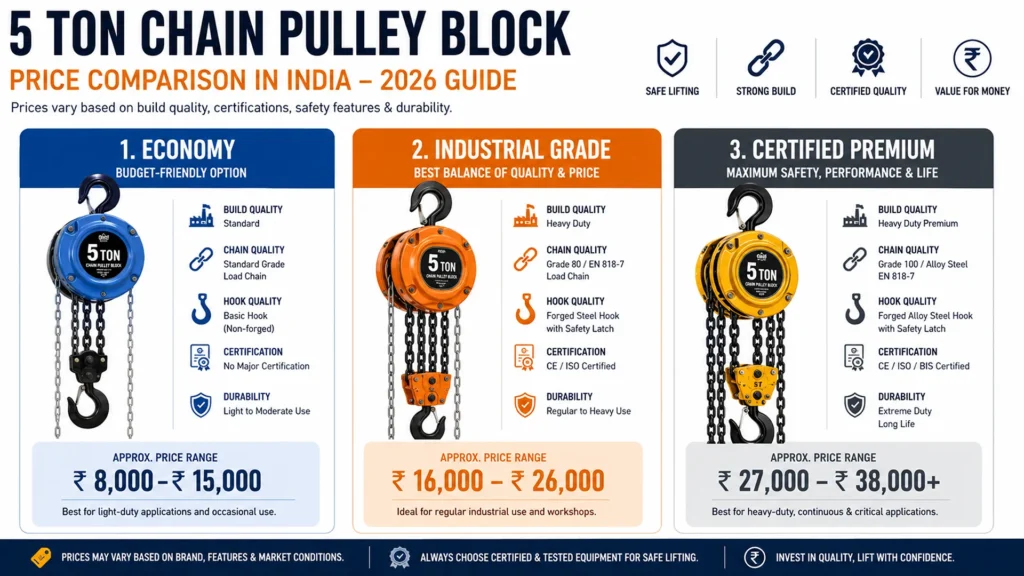
If you’re simply looking for the typical 5 ton chain pulley block price in India, the table below gives a practical starting point. These are general market ranges for standard 3-metre lift models. Actual prices can vary depending on the manufacturer, specifications, certifications, and dealer.
| Category | Typical Price Range (India) | Best Suited For |
|---|---|---|
| Economy | ₹8,000–₹15,000 | Light-duty applications, occasional maintenance work, and budget-conscious buyers. |
| Industrial Grade | ₹15,000–₹28,000 | Factories, workshops, warehouses, and regular daily lifting operations. |
| Certified Premium | ₹28,000–₹38,000+ | Heavy industrial use where documented testing, higher-quality components, and recognised certifications are required. |
Here’s what these tiers generally mean:
- Economy models are suitable for users who need a manual lifting solution for infrequent use. They can be a practical choice for small workshops or maintenance jobs, provided they are purchased from a reliable supplier.
- Industrial-grade models are designed for more frequent operation and typically offer better durability, smoother lifting performance, and longer service life under demanding conditions.
- Certified premium models are intended for industries where safety documentation, consistent performance, and compliance with applicable standards are important. These products often undergo additional quality testing and use higher-grade components.
Important: The price ranges above assume a standard 3-metre lifting height. If you need a longer lift—such as 6 metres, 9 metres, or more—the additional load chain and lifting chain will increase the overall cost. Lift height is one of the biggest pricing factors and is covered in the next section.
Why the Price Varies So Much for the “Same” Capacity
If you’ve compared a 5 ton chain pulley block price, you’ve probably noticed something confusing. Two products may both claim a 5-ton lifting capacity, yet one costs significantly more than the other.
That difference is rarely just about the brand name. In most cases, it comes down to the quality of the materials, the engineering, the manufacturing process, and the testing behind the product. Understanding these differences helps you choose a chain pulley block that matches your application rather than simply picking the cheapest option.
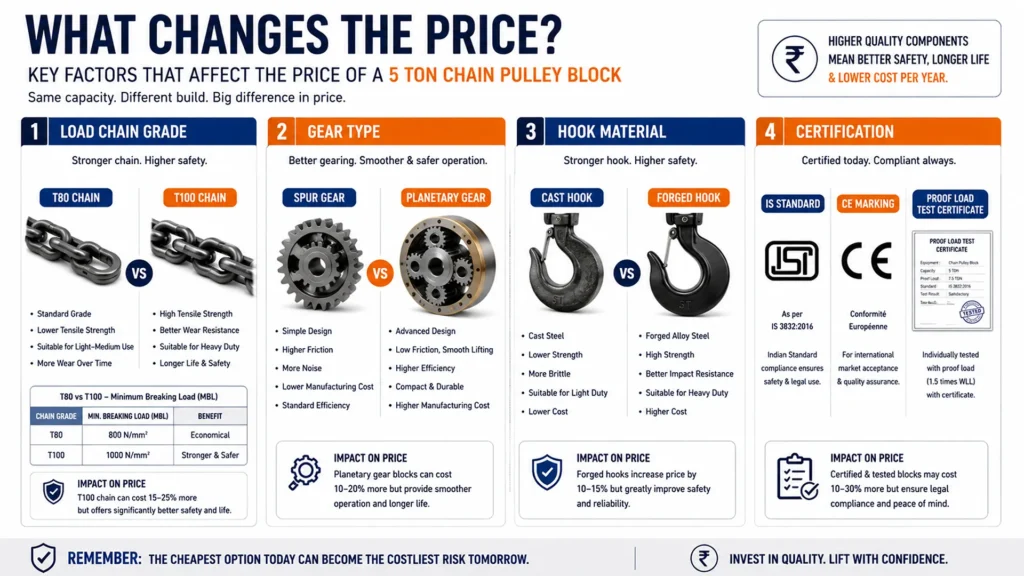
Load Chain Grade (T80 vs T100)
One of the biggest factors affecting price is the grade of the load chain.
The load chain is the part that directly supports the lifted load, so its strength and quality are critical.
Common grades include:
- Grade T80 (Grade 80): Widely used in industrial lifting applications and suitable for many heavy-duty jobs.
- Grade T100 (Grade 100): Offers higher strength than Grade 80, allowing manufacturers to use a smaller or lighter chain while maintaining the same safe working load (SWL).
A higher-grade chain generally provides benefits such as:
- Reduced chain weight
- Easier manual operation
- Better strength-to-weight ratio
- Improved handling during installation and use
However, higher-grade alloy steel chains are more expensive to manufacture and require stricter quality control. This contributes to a higher overall price for the chain pulley block.
Gear Type — Spur vs Planetary
The internal gearing also has a noticeable effect on both performance and cost.
Spur gear systems have a straightforward design that has been used for many years. They are reliable, easier to manufacture, and usually cost less. They are commonly found in standard manual chain pulley blocks.
Planetary gear systems use multiple gears that distribute the load more evenly. This design offers several advantages:
- Smoother lifting operation
- Better load distribution
- Higher efficiency
- Reduced wear over time
- More compact gear arrangement
Because planetary gear systems involve more precision machining and additional components, they generally cost more than spur gear designs.
Body & Hook Material (Mild Steel vs Alloy Steel, Forged vs Cast Hooks)
The construction of the body and hooks plays a major role in both safety and durability.
Many premium chain pulley blocks use alloy steel components because they offer greater strength and resistance to wear than ordinary mild steel.
The hook manufacturing process is equally important.
Forged hooks are preferred for lifting equipment because the forging process aligns the metal’s grain structure, improving strength and toughness. They are commonly used in quality industrial lifting equipment.
Cast hooks, on the other hand, are generally considered a warning sign for heavy-duty lifting applications. Casting can introduce internal defects such as voids or porosity if manufacturing quality is poor. For a 5-ton chain pulley block, forged hooks are generally regarded as the safer and more reliable choice.
Certification & Testing (IS 3832, IS 6216, CE, Proof-Load Testing)
Certification is another major reason why two products with the same rated capacity may have very different prices.
Manufacturers that comply with recognised standards invest in better materials, controlled manufacturing processes, inspection, and testing.
Depending on the product and market, you may see certifications or standards such as:
- IS 3832 for manually operated chain pulley blocks
- IS 6216 for lifting chains
- CE marking for products supplied to applicable European markets
- Proof-load testing to verify that the equipment can safely withstand a specified test load before being placed into service
While certification increases manufacturing costs, it provides greater confidence that the equipment has been produced and tested according to recognised requirements.
By contrast, very low-priced, uncertified chain pulley blocks may skip documented testing, use lower-grade materials, or lack proper quality assurance. Although they may appear similar externally, the difference often becomes clear in long-term reliability, durability, and, most importantly, lifting safety.
Lift Height and Its Real Effect on Price
One of the biggest factors that affects a 5 ton chain pulley block price is the required lift height. Many buyers compare prices without checking the chain length, which can lead to incorrect assumptions.
For most manufacturers, a 3-metre lift height is the standard configuration and serves as the base price. If you need a longer lifting distance, the additional cost mainly comes from the extra load chain, hand chain, and the larger chain storage required.
While prices vary by brand and chain grade, a practical way to estimate the increase is to expect an additional cost for every extra metre of lift height. As a general guide:
| Lift Height | Price Impact |
|---|---|
| 3 m | Standard base price |
| 6 m | Additional cost for 3 extra metres of chain |
| 9 m | Higher increase due to 6 extra metres |
| 12 m | Premium pricing because of significantly longer chains |
Not every application requires an extended lift height. A standard 3 m lift is suitable for many workshops, warehouses, and maintenance jobs. Heights of 6 m or more are usually needed in factories with high ceilings, construction sites, steel fabrication units, or overhead crane installations.
Some buyers are encouraged to purchase longer lift heights “just in case.” Unless your working environment genuinely requires it, paying for extra chain length increases the purchase cost, equipment weight, and handling effort without providing any real operational benefit.
Manual vs Electric (Motorized) 5 Ton Chain Block — Which Is Worth It?
Choosing between a manual and an electric 5 ton chain block is not simply about buying the cheaper option. The better choice depends on how often the equipment will be used, how much time each lift takes, the availability of power, and the overall operating cost over its service life.
Upfront Price Difference
At the same 5-ton lifting capacity, a manual chain block is considerably less expensive than an electric chain hoist. The manual version has a simpler mechanical design, requires no electrical components, and generally costs less to purchase and maintain.
An electric or motorized model includes an electric motor, gearbox, controls, braking system, and electrical protection features. These additional components increase the initial investment. Installation may also involve power supply arrangements, mounting accessories, or trolley systems, depending on the application.
For businesses with occasional lifting needs, the lower purchase price of a manual unit can make it the more practical investment.
The Breakeven Math (Lift Frequency vs Labour Cost)
Instead of focusing only on the purchase price, consider the total cost of ownership.
A simple way to evaluate the investment is to compare:
- Number of lifts performed each day
- Time saved on every lift with an electric hoist
- Labour cost of the operator
- Additional purchase price of the electric model
- Electricity and maintenance costs
If your team performs only a few lifts each day, the time savings may not justify the higher initial cost.
However, if lifting operations are repeated throughout every shift, even small time savings per lift can add up over weeks and months. Faster lifting cycles may also reduce operator fatigue and improve workflow, especially in production lines, fabrication shops, and logistics facilities where lifting is a routine part of daily operations.
Rather than asking, “Which one is cheaper?” the better question is, “Which one reduces my overall operating cost over time?”
When Manual Still Wins
Despite the advantages of motorized lifting, manual chain blocks remain the better option in many situations.
A manual 5 ton chain block is often the right choice when:
- The equipment is used only occasionally.
- The worksite has limited or no reliable electricity supply.
- The lifting location changes frequently and portability is important.
- Budget constraints make a lower upfront investment a priority.
- Maintenance simplicity is preferred in remote or demanding environments.
For maintenance teams, construction sites, equipment installation, and emergency lifting tasks, a manual chain block continues to be a dependable and cost-effective solution. If lifting is not continuous throughout the day, paying significantly more for an electric model may offer little financial benefit. The best decision comes from matching the equipment to the actual workload rather than choosing the most advanced option available.
The Real Cost of Owning a 5 Ton Chain Pulley Block (Beyond the Sticker Price)
When comparing the 5 ton chain pulley block price, many buyers focus only on the purchase cost. However, the actual cost of ownership is much broader. Looking at the total cost of ownership (TCO) helps you avoid unexpected expenses and make a better long-term buying decision.
If your lifting application requires horizontal movement, you may also need a compatible trolley. Depending on your setup, this could be a push trolley, geared trolley, or electric trolley. Since a trolley is often sold separately, it should be included in your budget if required.
Another important item is the initial test certificate. Reputable manufacturers usually supply a test certificate showing that the chain pulley block has been tested according to the applicable standard before leaving the factory. This document is valuable for safety records, inspections, and compliance requirements.
Over time, periodic inspections become part of the ownership cost. Many workplaces schedule annual load testing or third-party inspection (TPI) based on company policies, industry practices, or local regulatory requirements. These inspections help verify that the equipment remains safe for continued use.
Like any mechanical lifting equipment, a chain pulley block also requires regular maintenance. Common wear parts include:
- Pawls
- Load hooks
- Load chain
- Bearings and other moving components
Replacing worn parts before they fail improves safety and helps extend the service life of the equipment. Choosing a manufacturer that offers readily available spare parts can reduce downtime when maintenance is needed.
A simple five-year ownership example illustrates why purchase price alone can be misleading.
| Cost Component | Typical Consideration |
|---|---|
| Initial purchase | Chain pulley block and accessories |
| Trolley (if required) | Additional purchase cost |
| Initial test certificate | May be included or charged separately |
| Annual inspections | Periodic testing or third-party inspection |
| Maintenance | Lubrication, servicing, spare parts replacement |
| Repairs | Replacement of worn components when necessary |
A chain pulley block with a slightly higher purchase price but better build quality, stronger after-sales support, and easily available spare parts may offer a lower total ownership cost over its working life.
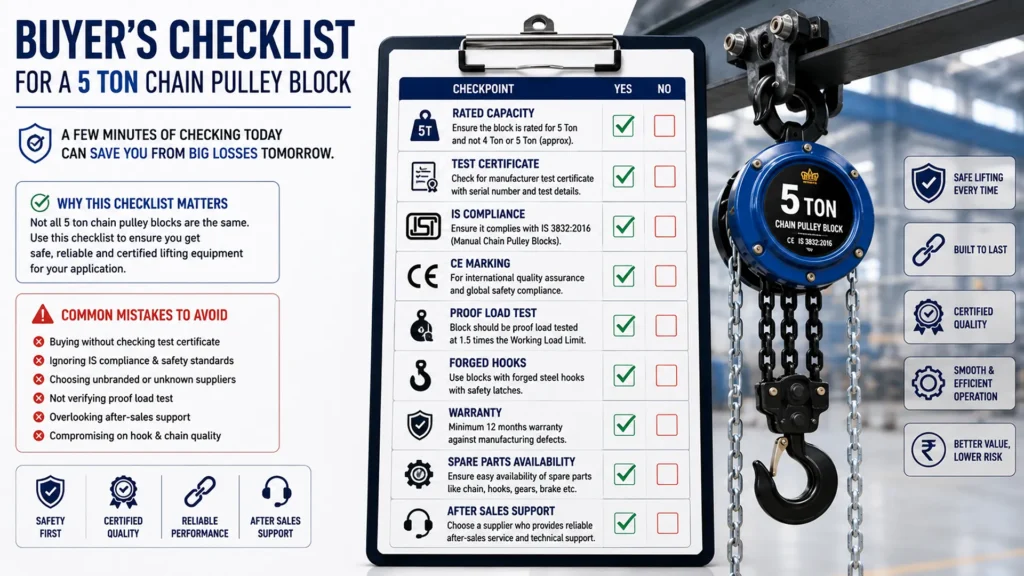
Buyer’s Checklist — What to Verify Before You Pay
Buying a 5 ton chain pulley block is not just about finding the lowest price. It is about ensuring the equipment is safe, genuine, and suitable for your lifting application. Before placing an order, take a few minutes to verify the following points.
First, confirm the actual rated capacity. Do not rely only on the capacity printed on the label. Ask the supplier for the product specifications and supporting test documents that verify the equipment has been tested for its stated working load.
Next, request the essential documents. A reliable supplier should be able to provide:
- Test certificate
- Details of the applicable IS or other recognised standard followed by the product
- Warranty terms and conditions
- User or operation manual
If any of these documents are unavailable or incomplete, ask for clarification before making a purchase.
Be cautious when buying from the unorganised market. Poor-quality or incorrectly labelled lifting equipment may use lower-grade materials or lack proper quality control. Warning signs include unusually low prices, missing identification plates, incomplete documentation, poor finishing, or suppliers who cannot explain product specifications.
It is also worth asking a few practical questions before placing your order:
- Are spare parts readily available?
- How long are replacement chains and hooks supported?
- Is after-sales service available?
- What is the warranty period?
- Can the supplier assist with maintenance or inspections if required?
Finally, choose a supplier with experience in lifting equipment rather than selecting purely on price. Good technical support, proper documentation, and dependable after-sales service can make a significant difference throughout the equipment’s working life. Taking the time to verify these details helps ensure you receive a genuine, compliant, and reliable 5 ton chain pulley block that supports safe lifting operations.
Should You Rent Instead of Buy?
If you only need lifting equipment for a short period, renting a 5 ton chain pulley block can be the more practical and cost-effective option. Many contractors, maintenance teams, and factories rent lifting equipment for shutdown work, equipment installation, or one-time projects instead of investing in a new unit.
Renting often makes sense when:
- The lifting job is temporary or a one-off project.
- You are unsure whether you’ll need the equipment again.
- Storage and maintenance costs are difficult to justify.
- You need different lifting capacities for different jobs.
Rental rates vary depending on the location, brand, lift height, and rental duration. In many cases, daily and weekly rental charges are significantly lower than the upfront purchase cost of a new 5 ton chain pulley block, making rental an economical choice for short-term work. However, if the equipment will be used regularly over several months or years, buying usually offers better long-term value.
Another factor that buyers often overlook is resale value. A well-maintained chain pulley block from a recognised manufacturer may retain some value if sold after the project. However, resale prices depend on the equipment’s condition, maintenance history, age, and market demand, so they should not be the primary reason for purchasing.
Frequently Asked Questions
The price generally ranges from around ₹8,000 for basic manual models to ₹40,000 or more for premium brands, longer lift heights, and heavy-duty industrial specifications.
A chain pulley block is manually operated using a hand chain, making it suitable where electricity is unavailable or occasional lifting is required. An electric hoist uses a motor to lift loads faster and with less physical effort, making it better suited for frequent industrial operations.
Yes. Most manufacturers can supply custom lift heights. Increasing the lift height usually increases the price because additional load chain, hand chain, and supporting components are required. The exact cost depends on the requested lift height and the manufacturer.
Look for products manufactured to recognised quality and safety standards. Depending on the manufacturer and intended application, this may include compliance with relevant Indian Standards, ISO-certified quality management systems, and proof load testing or inspection certificates where applicable.
Yes. Renting is common for construction projects, factory maintenance shutdowns, equipment installation, and short-term industrial work where purchasing new equipment would not be cost-effective.
Final Takeaway
The 5 ton chain pulley block price is only one part of the buying decision. A lower price may not offer the best value if the product lacks the required load capacity, build quality, certifications, or durability. Consider the total ownership cost, including maintenance, expected usage, and long-term reliability. If your requirement is temporary, renting may be the smarter option. If you need regular lifting, compare specifications carefully and request quotations from trusted suppliers before making your final decision.