 trivedi associate July 15, 2026
If you operate cranes, hoists, chains, or any lifting equipment, you’ve likely heard the term “third-party inspection certificate” thrown around in safety meetings or compliance audits. But here’s what most people don’t know: having one is often the difference between staying operational and facing hefty fines—or worse, a serious workplace accident.
The problem is, plenty of facility managers and equipment owners remain confused about what this certificate actually covers, who really needs it, and whether their current documentation is even valid. This guide cuts through that confusion. We’ll walk you through exactly what a third-party inspection certificate is, which standards apply to your equipment, what the inspection process looks like, how often you need it renewed, and what risks you’re taking if you skip it. By the end, you’ll know precisely what to look for and why it matters.
What Is a Third-Party Inspection Certificate for Lifting Equipment?
A third-party inspection certificate is an official document issued by an independent, accredited inspection body confirming that your lifting equipment is safe to use and meets legal safety standards. It’s not just a rubber stamp—it’s evidence that a qualified inspector has physically examined your equipment, tested it under load (where required), and verified that everything works as it should.
Here’s the key distinction: an inspection is the physical examination itself. A certificate is the proof that the inspection happened and what the results were. Many people use these terms interchangeably, but they’re not quite the same thing. The certificate is your documented evidence that the inspection was thorough and performed by someone with real authority to say so.
The crucial part is “third-party.” That means the inspector isn’t the manufacturer trying to sell you the equipment, and it’s not your own maintenance team (no matter how competent they are). It’s an independent body with no financial stake in whether your equipment passes or fails. That independence is what gives the certificate legal and insurance weight.
First-Party vs. Second-Party vs. Third-Party Inspection
This is where the confusion starts for most people. Let’s break it down:
First-party inspection is you inspecting your own equipment. Your maintenance team does a visual check, runs some tests, and signs off. It’s internal, and while it’s important for day-to-day safety, it holds no legal weight on its own in most jurisdictions.
Second-party inspection is when someone related to the transaction inspects the equipment—typically the manufacturer or supplier. They have a vested interest in the equipment being approved because they’re selling it. Again, useful, but not enough for compliance.
Third-party inspection is an independent, accredited inspector from outside your organization—someone with no stake in the outcome. This is what regulators and insurers actually care about. When a third-party inspector signs off, it means an unbiased expert has verified safety. That’s legally significant.
Manufacturer Certificate vs. Third-Party (TPI) Certificate — Do You Need Both?
This is the question that comes up constantly. You receive a certificate from the manufacturer when equipment ships to you. Isn’t that enough?
Short answer: No. Manufacturer certificates prove the equipment left the factory in good condition. They don’t account for wear, damage, misuse, or the passage of time. Most regulations (LOLER in the UK, for example) require a third-party inspection within 12 months of purchase and then regularly after that—typically annually for most lifting gear.
So yes, keep the manufacturer’s certificate in your records. It’s part of your documentation chain. But you absolutely need third-party inspection certificates too. They’re not redundant; they’re complementary. The manufacturer says “it was safe when it left here.” The third-party inspector says “it’s safe right now.” That’s the critical difference.
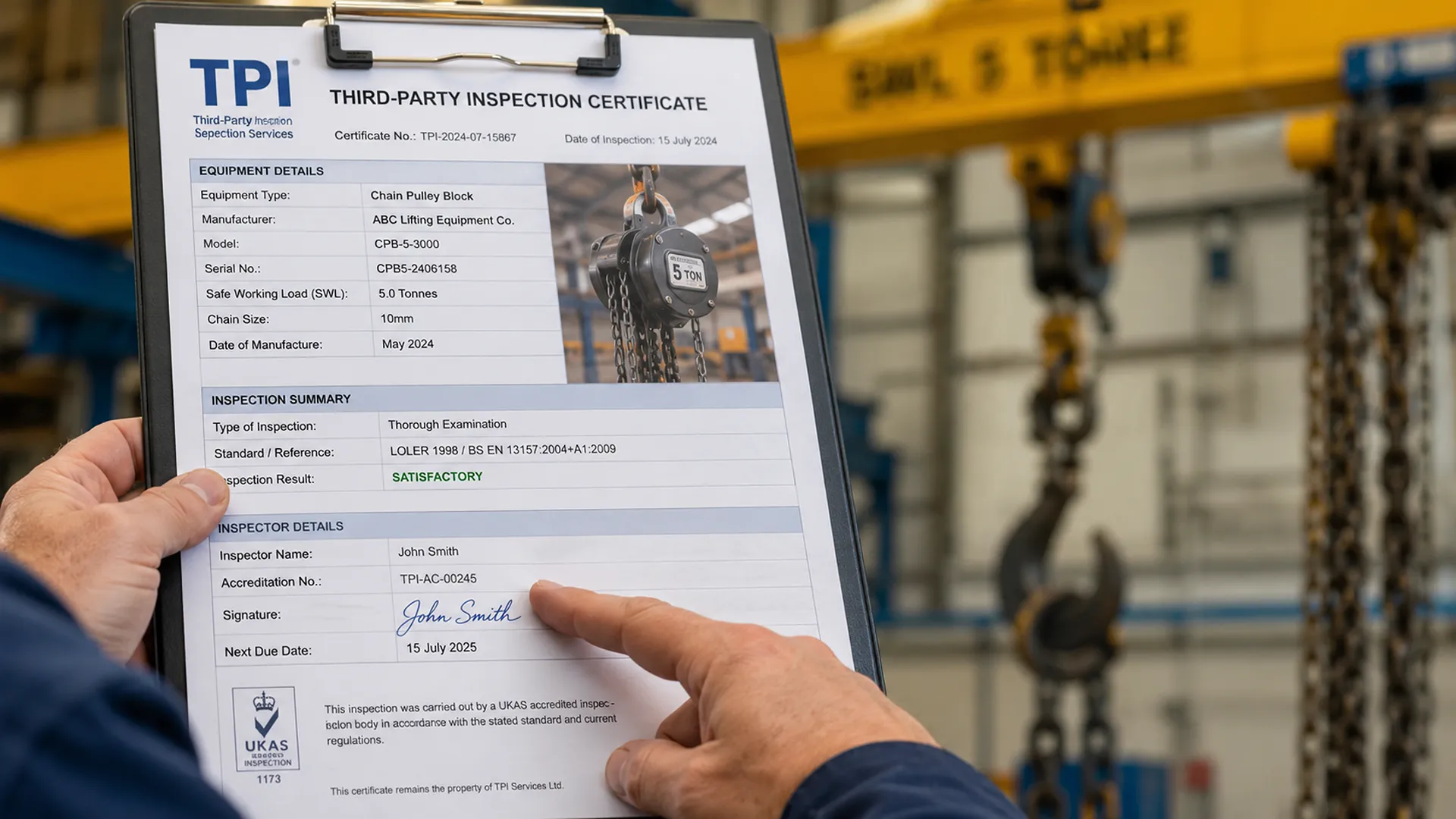
What’s Included on a Valid Certificate? (Anatomy Breakdown)
Not all certificates are created equal. A proper third-party inspection certificate has specific fields and information that make it legally defensible. If any of these pieces are missing or incomplete, the certificate is compromised—and so is your compliance standing.
Key Fields Every Certificate Must Have
A valid certificate should include:
Equipment ID and Serial Number — This ties the certificate to your specific piece of equipment, not just a generic model. It’s usually stamped on the equipment itself.
Safe Working Load (SWL) — The maximum weight the equipment can safely lift. This must be clearly stated. If it’s missing, the certificate is suspect.
Inspection Date — When the physical inspection actually happened.
Next Inspection Due Date — Usually 12 months out, but can vary by equipment type and regulation. This tells you when to schedule the next check.
Inspector Name and Accreditation Number — Not just a signature from “Bob from maintenance.” The inspector must be individually accredited (LEEA, NASC, or equivalent) so you can verify their credentials.
Standard Referenced — Which regulation or standard the inspection was performed against (LOLER, OSHA, Factories Act, etc.). This matters because different regions have different rules.
Pass/Fail Result — Clear statement of whether the equipment passed or failed. There’s no “mostly okay” in a proper certificate.
Authorized Signature and Stamp — A legitimate inspector’s signature plus their organization’s official stamp. These can be digital now, but they must be verifiable.
Red Flags — Signs a Certificate Isn’t Valid
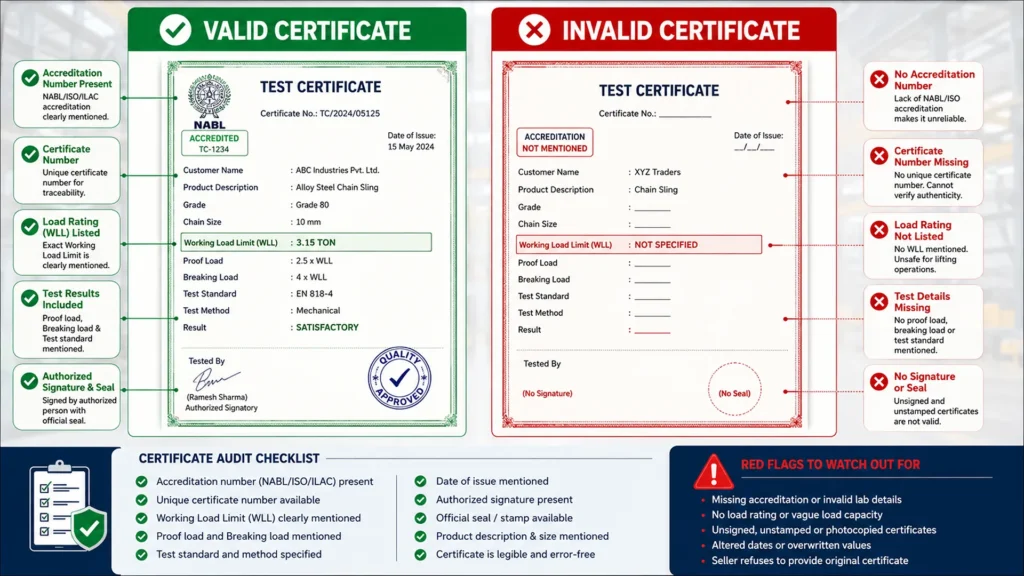
Watch out for these warning signs:
Missing accreditation number — If you can’t verify the inspector’s credentials, the certificate is worthless. It’s like getting a medical diagnosis from someone with no medical license.
No load rating listed — If the SWL isn’t stated clearly, you don’t actually know what the equipment is certified to lift. That’s a major gap.
Expired validity — A certificate dated three years ago is useless. Most equipment needs annual re-inspection. Expired means you’re technically non-compliant.
Unsigned or unstamped — If the document isn’t officially signed and stamped by an accredited inspector or organization, it’s not a real certificate. Anyone can print an official-looking form.
Vague language — Phrases like “equipment appears satisfactory” instead of a clear pass/fail are red flags. Proper certificates are specific.
Which Standards Apply? (Global Comparison)
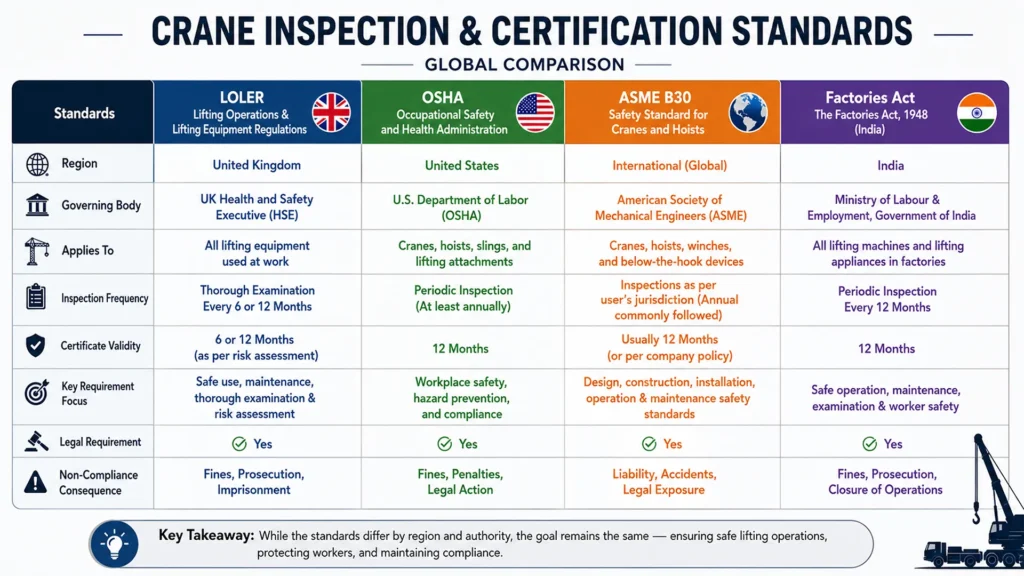
The lifting equipment world doesn’t have one universal rulebook. Different countries and regions have their own standards, and it matters because they determine who can inspect your equipment, how often, and what the certificate must cover.
Here’s the landscape:
| Standard | Region | Inspection Frequency | Who Can Certify | Certificate Validity |
|---|---|---|---|---|
| LOLER | UK & EU | Annual (minimum) | Competent person or accredited body | 12 months |
| OSHA / ASME B30 | USA | Varies by equipment type (6–12 months typically) | Qualified inspector or third-party body | Depends on type, usually 12 months |
| Factories Act 1948 | India | Annual | Competent person (government-approved) | 12 months |
| LEEA | Global (membership body) | Follows regional regs; sets best practices | LEEA-certified inspectors | 12 months |
LOLER (UK) is one of the strictest frameworks. If you’re operating in the UK, you’re required to have thorough examination and testing—that’s the formal term—by a competent person, typically meaning a third-party accredited body. No exceptions.
OSHA and ASME B30 (USA) are more flexible in some ways. OSHA prescribes certain frequencies (cranes every 12 months, for example), but it’s often the equipment manufacturer’s manual that sets specific re-inspection intervals. A qualified inspector—which can sometimes mean an internal person with documented training—can sign off, though third-party certification is still the gold standard for risk management.
India’s Factories Act 1948 requires inspection of lifting machinery at least once annually by a competent person. The government maintains a register of approved inspectors.
LEEA isn’t a legal mandate—it’s a global membership body (Lifting Equipment Engineers Association) that sets industry best practices and certifies inspectors. If an inspector is LEEA-certified, they’re held to a high standard regardless of location. It’s a mark of professionalism.
How the Inspection Process Actually Works
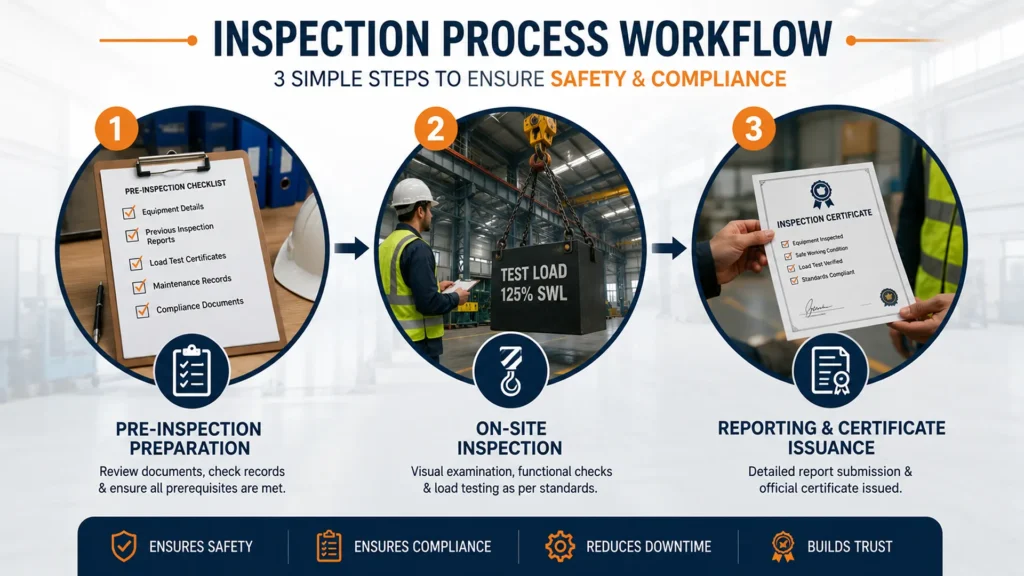
A lot of people think third-party inspection is mysterious or overly complicated. It’s not. It’s a straightforward, repeatable process. Here’s exactly what happens:
Step 1 – Pre-Inspection Preparation
Before the inspector arrives, groundwork happens. Your maintenance records are reviewed—repair history, previous inspection reports, any modifications you’ve made. The inspector needs access to the equipment, which means scheduling around your production schedule. They’ll also confirm the load rating and current usage conditions. This prep work typically takes a day or two before the on-site visit.
Step 2 – On-Site Inspection
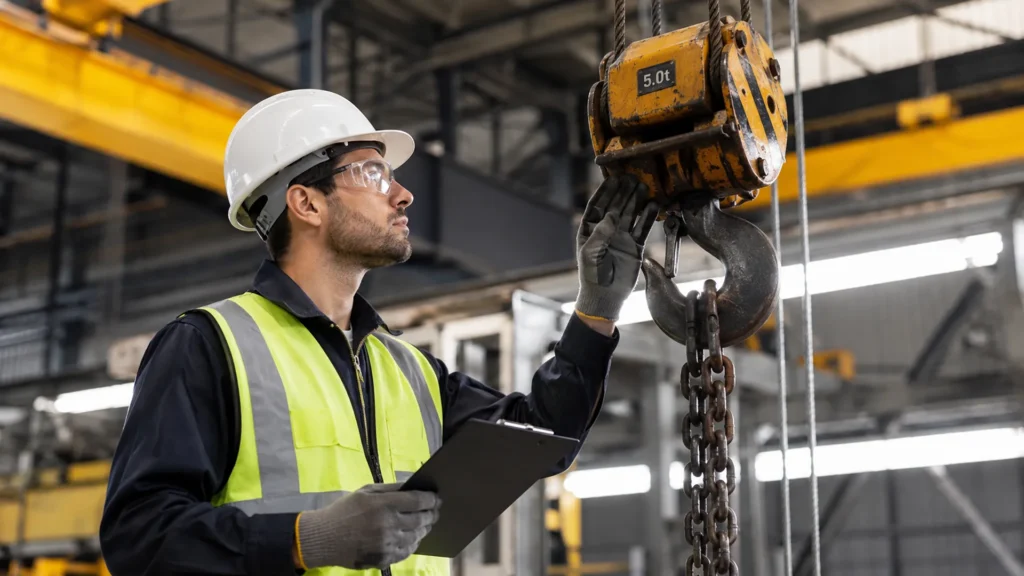
The inspector arrives and performs a thorough visual examination—checking for cracks, rust, wear on chains or straps, corrosion, damage to hooks or shackles, and mechanical wear on moving parts. For many types of equipment (particularly chains, slings, and hooks), they’ll also conduct load testing or proof testing. This means actually applying a known load to verify the equipment holds it safely. Functional tests confirm that brakes work, controls respond correctly, and safety devices (like limit switches) function properly. This part of the process takes anywhere from a few hours to a full day depending on equipment complexity.
Step 3 – Reporting & Certificate Issuance
After inspection, the inspector compiles their findings into a report and issues the certificate. Turnaround is typically 5–10 working days, though some providers offer faster service for an additional fee. Certificates can now be issued digitally (usually PDF format), which is legally valid in most regions. If equipment fails inspection—meaning it doesn’t meet safety standards—the certificate will state that. At that point, the equipment is out of service until repairs are made and a re-inspection confirms it’s safe again.
How Often Does Lifting Equipment Need Re-Inspection?
The simple answer: at least annually for most equipment. But it’s more nuanced than that.
Standard re-inspection intervals are typically 12 months for cranes, hoists, chains, and slings in most regulatory frameworks. However, some equipment types have shorter cycles. Chains and slings used in harsh environments might need 6-month inspections. Your specific equipment’s manual and the applicable regulation will clarify the exact frequency.
What triggers early re-inspection? If equipment is repaired or modified, it needs re-inspection before going back into service. If there’s an incident—even a minor drop or impact that doesn’t cause visible damage—a competent person should assess it, and formal re-inspection may be warranted. If equipment sits unused for extended periods (dormancy), it should be inspected before returning to service. Environmental factors matter too; equipment in corrosive environments (salt air, chemical exposure) may degrade faster and require more frequent checks.
The key principle: re-inspection isn’t just box-ticking. It’s verification that your equipment is still safe to use right now.
How Much Does Third-Party Inspection Cost?
The cost of third-party inspection varies significantly depending on several factors. A basic annual inspection of a small item like a chain sling or lifting strap might cost between £50–£150 (roughly $65–$195 USD). A comprehensive inspection of a large overhead crane or complex rigging system could easily run £500–£2,000 or more.
What drives the price? Equipment size and complexity are the biggest factors. A small manual hoist takes less time than a 10-ton electrical crane. Location matters too—urban areas with more competitive inspection services are often cheaper than remote regions. Urgency affects cost; expedited inspection turnaround (24–48 hours) usually costs extra.
The harsh reality competitors won’t tell you: the cheapest inspection isn’t always the best value. A cut-rate provider might rush through the process or lack proper accreditation. Paying a fair price for a thorough, accredited inspection protects you from liability and equipment failure. Think of it as insurance—a modest investment now prevents catastrophic costs later.
What Happens If You Skip Third-Party Inspection?
Ignoring third-party inspection requirements isn’t just poor practice; it’s legally and financially risky.
Regulatory fines are immediate consequences. In the UK, the Health and Safety Executive (HSE) can fine organizations up to £20,000 or more for non-compliance with LOLER inspection requirements. In the USA, OSHA penalties can similarly escalate. India’s Factories Act carries fines and potential imprisonment for serious violations. These aren’t theoretical risks—they happen regularly.
Insurance claim denial is another major consequence. If an accident occurs involving lifting equipment that’s out of certification, your insurer can refuse to pay the claim. You’re left covering medical bills, equipment damage, and legal costs out of pocket. That’s potentially catastrophic.
Failed audits and operational shutdown occur when clients, auditors, or regulators discover you’re non-compliant. Major contracts often require proof of current third-party inspection. Missing that documentation can cost you business.
Real-world incident: A facility in the UK continued operating a chain hoist past its inspection due date. When the chain broke and injured a worker, the HSE investigated and discovered the equipment was out of compliance. The company faced both criminal charges and civil liability because they’d skipped inspection. The cost: fines, litigation, medical settlements, and reputational damage—far exceeding what an annual inspection would have cost.
The message is simple: inspection is mandatory for a reason. It’s cheaper, safer, and smarter than the alternative.
How to Choose the Right Third-Party Inspection Provider
Finding a reliable inspection provider isn’t complicated if you know what to look for.
Check accreditation first. Verify the inspector or organization holds credentials from LEEA, NASC, ISO 17020, or the equivalent body in your region. Don’t assume; ask for proof and verify independently if possible. An accredited inspector is held to auditable standards.
Ask about experience with your specific equipment type. A provider certified for overhead cranes might not be the best fit if you need chain sling inspection. Specialization matters. Request references from similar clients.
Clarify turnaround time and reporting. How quickly will you get your certificate? Will it be digital or physical? Can they provide detailed reports that satisfy your insurance company? Transparency here indicates professionalism.
Compare pricing, but not on price alone. If one provider’s quote is drastically cheaper, ask why. Faster inspections aren’t thorough inspections. A fair price from an accredited, experienced provider is worth the investment.
Check communication style. Do they explain findings clearly? Will they help you understand what failed (if anything) and how to fix it? A good provider educates, not just inspects.
Frequently Asked Questions
Most third-party inspection certificates are valid for 12 months from the inspection date. Some equipment types or higher-risk applications may require 6-month intervals. Always check your certificate for the “Next Inspection Due” date and your regional regulations—validity periods can vary.
A competent person has formal training, practical experience, and recognized qualifications in lifting equipment inspection. This typically means someone accredited by LEEA, NASC, or an equivalent body. Internal staff rarely qualify unless they’ve completed specialized training and hold official certification. Third-party inspectors are always competent persons by definition.
It depends on your regulations and insurance terms. Most frameworks allow brief operational use between the inspection due date and actual re-certification—typically a grace period of a few weeks. However, once the certificate expires, continued use is non-compliant and voids insurance. Don’t gamble; schedule re-inspection before the deadline.
No. Manufacturer certificates prove equipment was safe at the point of delivery, not that it’s safe now. Regulations require third-party inspection to account for wear, damage, and time-related degradation. Both documents matter, but third-party inspection is mandatory for ongoing compliance.
Equipment that fails inspection must be taken out of service immediately. The inspector will document what failed. You then have the equipment repaired or replaced, schedule a re-inspection, and get re-certified before using it again. Failure isn’t uncommon—it’s exactly what inspection is designed to catch before an accident happens.
Conclusion
A third-party inspection certificate isn’t bureaucratic red tape—it’s concrete evidence that your lifting equipment is safe to use and meets legal standards. It protects your workers, satisfies regulators and insurers, and keeps your operations running without interruption. The cost is modest compared to the liability, fines, and human cost of skipping it.
Now that you understand what these certificates cover, which standards apply to your equipment, and why they matter, the next step is straightforward: if your equipment is out of certification, schedule an inspection with an accredited provider today. If it’s current, mark your calendar for renewal well before the due date. That simple discipline keeps you compliant, safe, and protected.
Ready to get your equipment certified? Contact an accredited third-party inspection provider in your region—or reach out to discuss your specific inspection needs. We’re here to make compliance simple.