 trivedi associate July 9, 2026
Picking the wrong sling for a heavy lift isn’t just inefficient—it’s a safety hazard and a liability waiting to happen. Every day, riggers, construction crews, and industrial teams face the same question: should I use a wire rope sling or a chain sling for this job? The answer matters more than you might think. A sling that can’t handle the load, can’t withstand the environment, or fails inspection midway through a project creates downtime, cost overruns, and worst-case scenarios, worker injuries.
Here’s what most articles on this topic miss: they give you textbook answers without real numbers, cost breakdowns, or a framework you can actually use on the job site. This guide is different. By the end, you’ll know exactly which sling to grab, why it’s the right choice, and what conditions might force you to switch. We’ll cover strength specs, real-world cost comparisons, environmental limits, and the kind of judgment calls that only come from seeing both options in action.
Wire Rope Slings vs Chain Slings at a Glance
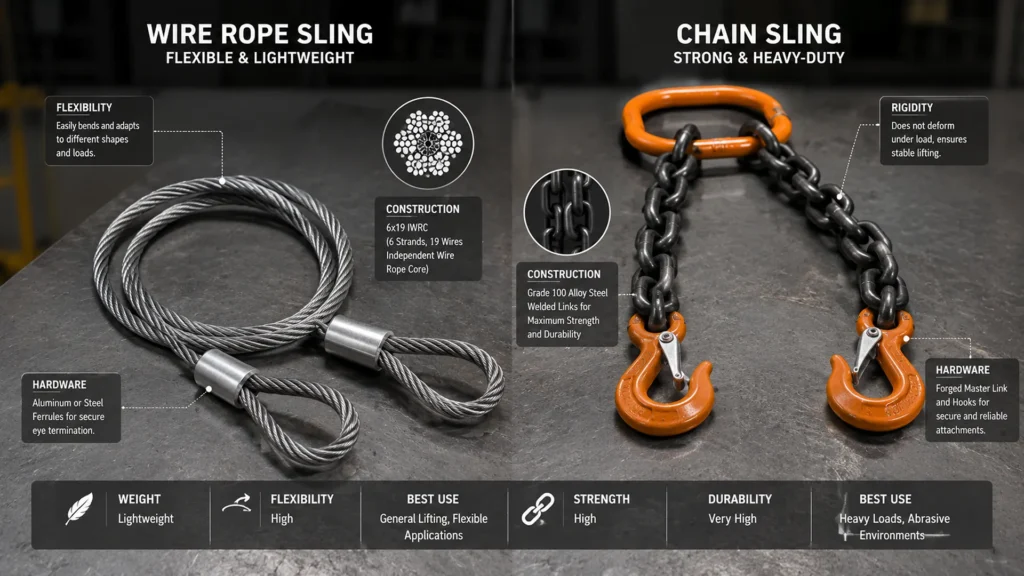
Before diving deep, here’s the quick answer for anyone in a hurry:
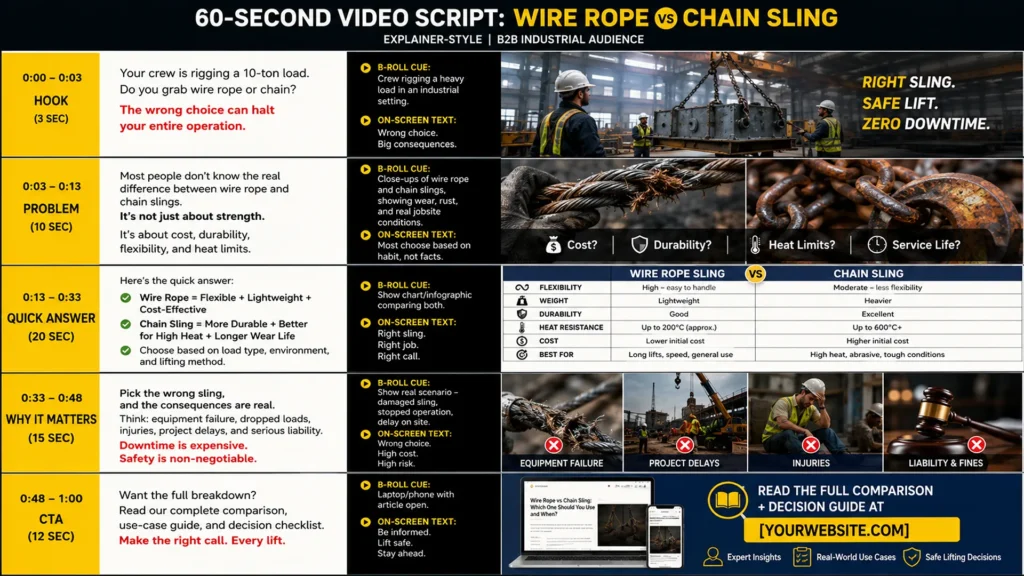
| Factor | Wire Rope Sling | Chain Sling |
|---|---|---|
| Strength-to-Weight | Lightweight, high capacity per pound | Heavier, but durable and repairable |
| Flexibility | Excellent around corners and angles | Rigid, needs spreader bars in many scenarios |
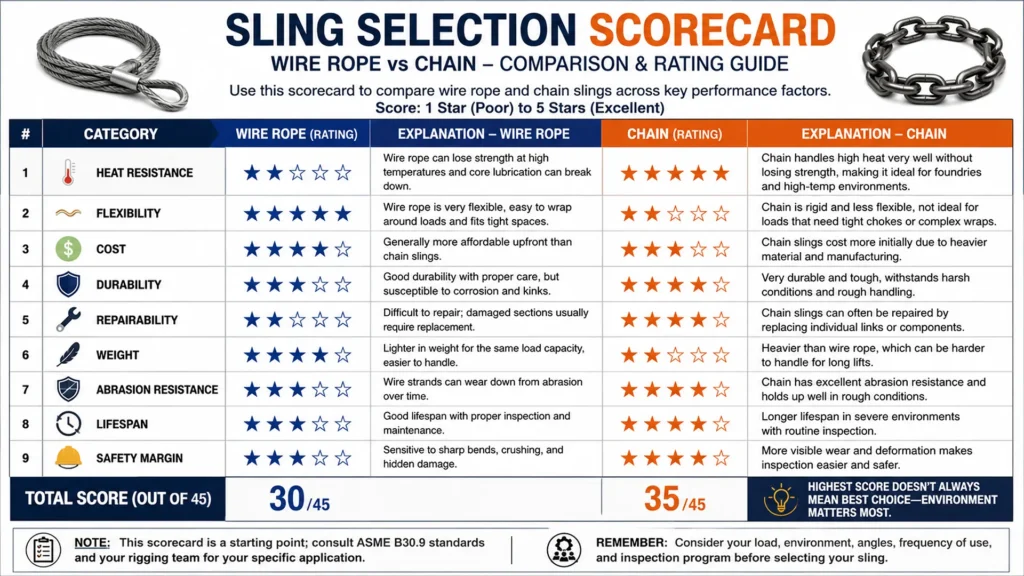
| Heat Resistance | Ceiling ~400°F | Tolerates 600°F+ |
| Abrasion Resistance | Vulnerable to sharp edges; needs edge protection | Tough but can nick and gouge |
| Cost (Upfront) | Lower purchase price | Higher upfront; lower lifetime cost often |
| Best Environment | General construction, moderate conditions | High-heat, high-abrasion, marine/chemical |
The bottom line: If you need lightweight, flexible rigging for general construction, wire rope wins. If you’re in a high-heat, high-abuse environment where durability and repairability matter, chain takes the crown.
What Is a Wire Rope Sling?
A wire rope sling is a loop of steel wire rope, usually with swaged (or pressed) eyes at each end and a hook or fitting attached for lifting. The rope itself is made from multiple strands of wire twisted around a central core—typically steel wire (IWRC) or natural fiber (FC). For heavy lifting, Grade EIPS (Extra Improved Plow Steel) is the standard you’ll see most often, offering a good balance of strength and cost.
Wire rope slings come in a few common configurations: single-leg slings, double-leg bridles, four-leg spreader bar setups, and endless slings (where the rope forms a complete loop with no splice). They’re the workhorse of construction sites, steel mills, and oil and gas operations because they’re affordable, easy to handle, and can flex around irregular loads without complaint.
The real advantage of wire rope is its strength-to-weight ratio. You can lift a massive load with a relatively thin rope—a 1-inch EIPS wire rope can handle over 10 tons safely. That flexibility makes it ideal for confined spaces where you can’t swing spreader bars or where the rigging needs to conform to the shape of the load. The downside? Wire rope is vulnerable to sharp edges, kinking, and once damaged, it’s done. Unlike chain, you can’t repair a broken wire rope sling; you destroy it and buy a new one.
What Is a Chain Sling?
A chain sling is what it sounds like: a chain of welded alloy steel links with hardened components like master links, hooks, or clevis fasteners attached at the ends. The alloy used determines the grade—Grade 80 and Grade 100 are the most common for lifting, with Grade 100 offering higher strength in the same diameter.
Chain slings are built for punishment. They excel in environments where wire rope would be slashed to pieces: hot steel mills with sharp edges, chemical plants, shipyards, and anywhere else where the load is aggressive or the surroundings are unforgiving. A chain sling can take nicks and gouges that would immediately disqualify a wire rope and still be usable after inspection.
What really sets chain apart from a total-cost perspective is repairability. A single damaged link can be cut out and replaced by a qualified chain specialist. The master links and hooks are reusable hardware that transfer to new chains as the old ones wear out. Over a five-year period in an active lifting operation, this repairability advantage adds up. Chain also handles heat better than wire rope—it stays strong well above 400°F, making it indispensable in hot-work industries. The trade-off is weight: chain is substantially heavier than wire rope at the same capacity, and it’s rigid, so you’ll need spreader bars and careful rigging geometry to avoid load imbalance.
Wire Rope vs Chain Sling: Strength & Load Capacity, By the Numbers
Working Load Limit (WLL) Comparison
This is where the specs start to matter. Working Load Limit (WLL) is the maximum safe load a sling can carry—it’s the number stamped on the hardware or printed on the tag. Here’s how wire rope and chain stack up at common sizes:
| Diameter | Wire Rope EIPS (Single-Leg, WLL) | Grade 80 Chain (Single-Leg, WLL) | Grade 100 Chain (Single-Leg, WLL) |
|---|---|---|---|
| 1/2″ | ~3.2 tons | ~3.1 tons | ~3.9 tons |
| 3/4″ | ~7.1 tons | ~7.0 tons | ~8.7 tons |
| 1″ | ~12.6 tons | ~12.4 tons | ~15.5 tons |
At first glance, wire rope and Grade 80 chain are nearly identical in capacity. Grade 100 chain edges ahead, but not dramatically. The real differences show up in multi-leg bridles, where the angles and rigging geometry matter enormously. A 4-leg bridle at 45 degrees can easily halve the safe working load compared to a vertical lift, and both wire rope and chain are affected the same way.
Design Factor Explained
Here’s a concept that separates safe rigging from sloppy practice: design factor. This is how many times stronger the sling is compared to its working load limit.
Wire rope slings typically use a 5:1 design factor. That means the sling’s breaking strength is five times its WLL. So a wire rope with a 10-ton WLL can theoretically break at 50 tons.
Chain slings typically use a 4:1 design factor. A 10-ton Grade 80 chain can break at around 40 tons.
Why the difference? Wire rope is more predictable—it fails gradually as wires break one at a time. Chain fails more suddenly once a link reaches its limit. The extra safety margin on wire rope compensates for this behavior difference. Both are safe when used correctly; they just get there through different engineering.
Strength-to-Weight Ratio
If you’ve ever loaded a truck or wrestled a sling up a ladder, weight matters. Wire rope dominates on this metric. A 1-inch EIPS wire rope weighs around 1.76 pounds per foot and can handle 12.6 tons. A 1-inch Grade 80 chain weighs roughly 3 pounds per foot for the same capacity. That’s nearly twice as heavy for the same lifting power.
In a multi-leg rigging scenario, that weight difference compounds. Rigging crews spend less energy handling wire rope, and the lighter weight reduces strain on the sling itself—less of the WLL is eaten up by the sling’s own mass. For high-frequency lifts or tight spaces where maneuverability matters, wire rope’s lightness is a genuine advantage.
Chain, by contrast, wins on durability per pound lifted. A chain sling that weighs more is also tougher, more resistant to damage, and more repairable. For long-term, harsh environments, that trade-off pays off over time.
Total Cost of Ownership: Wire Rope vs Chain Over 5 Years
Upfront Purchase Cost
Let’s start with the sticker price. A 1-inch EIPS wire rope sling with swaged eyes typically costs between $150 and $250, depending on length and hardware. A comparable 1-inch Grade 80 chain sling runs $400 to $600. That’s roughly 2–3 times more expensive upfront.
For a small operation or a one-off lift, wire rope’s lower purchase price looks like an easy win. But stretch your timeline to five years of regular use, and the picture shifts.
Inspection, Maintenance & Repair Costs
Wire rope slings require regular inspection—visually, mostly, looking for broken wires, corrosion, and kinking. A trained eye can spot problems in seconds. The catch: there’s no fixing them. A wire rope sling that fails inspection is destroyed and replaced. No salvage value, no second life.
Chain slings follow a different playbook. Inspection is also straightforward—look for stretched links, nicks, gouges, and deformed components. But here’s the advantage: individual damaged links can be removed and replaced by a qualified chain specialist, often for $50 to $150 per link, depending on grade. The master links and hooks stay in service and transfer to new chain segments. Over five years in an active rigging operation, this repairability advantage adds up fast. A single master link and hook set can support multiple chain segments as they wear out and get replaced.
Replacement Frequency & Downtime Risk
Here’s where total cost of ownership gets real. In a moderate-use environment (say, 10–15 lifts per week with mixed loads):
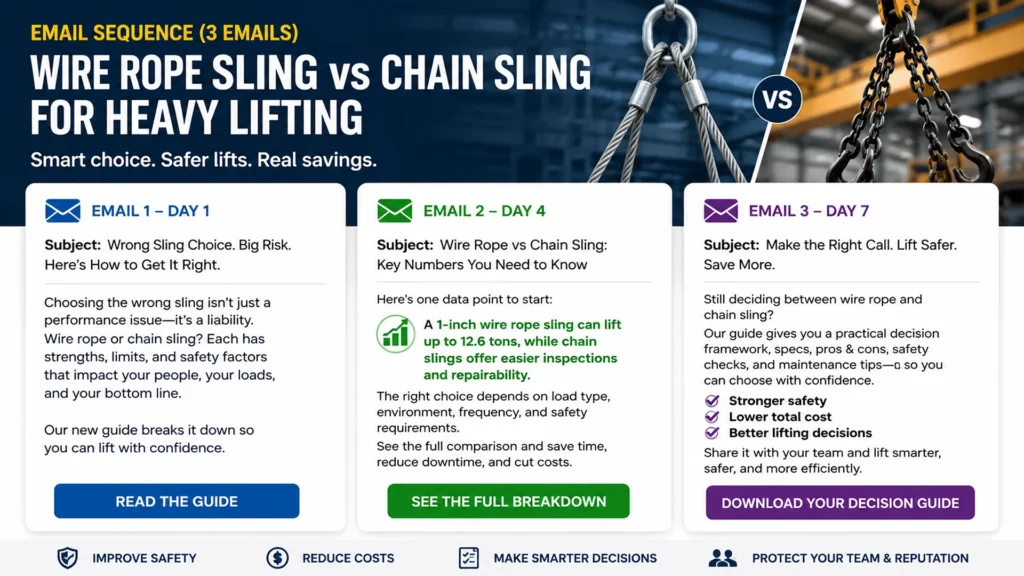
Wire rope scenario: A sling typically lasts 2–3 years before inspection failures or visible damage forces replacement. Budget two replacements in a five-year period at $150–$250 each = $300–$500 in materials. Add the labor time to inspect quarterly (minimal) and the downtime when a sling fails midway through a project and you have to wait for a replacement to arrive. That unexpected downtime costs far more than the sling itself—a delayed pour, a halted assembly line, or a crew sitting idle waiting for equipment.
Chain scenario: Initial purchase: $400–$600. Link replacements over five years: roughly $300–$500 (assuming 3–4 individual links fail and are replaced). The master link and hooks? They’re reused across multiple chain segments. Total materials: $700–$1,100. But here’s the offset: chain doesn’t fail suddenly. Damaged links are caught during inspection, and replacements are scheduled, not emergency. No unexpected downtime. No crews waiting around.
Rough 5-year cost model:
- Wire rope: $300–$500 (materials) + hidden downtime costs
- Chain: $700–$1,100 (materials) − zero downtime costs
The math shifts further in chain’s favor if you’re in a harsh environment where wire rope fails faster than normal. In a steel mill or chemical plant, wire rope might only last 12–18 months before the environment degrades it beyond safety limits. Chain, built for those conditions, can last 3–4 years.
Durability, Flexibility & Environmental Resistance
Heat & Temperature Limits
Wire rope has a ceiling: around 400°F. Beyond that, the steel loses strength, and the lubricating oils inside the rope break down. In a steel mill where loads sit near a furnace or in a foundry where ambient heat is constant, wire rope becomes unreliable fast.
Chain tolerates heat differently. Grade 80 and Grade 100 chain maintain acceptable strength up to 600°F. In extreme environments, special heat-treated chains rated to 800°F or higher exist, though they come at a premium. This heat tolerance is one reason chain dominates in steel processing, forges, and hot-work industries.
Cold is another story. Wire rope can become brittle below -40°F, losing flexibility and shock-absorption capacity. Chain also loses ductility in extreme cold, but it recovers those properties as temperature rises. For operations in Alaska or winter outdoor environments, both require careful handling and inspection; neither is ideal below -40°F, though chain is marginally more forgiving.
Abrasion, Corrosion & Chemical Exposure
Wire rope’s outer wires are soft steel—they abraded easily against sharp corners, rough edges, and concrete. Without edge protection (leather pads, corner guards), a wire rope sling can be destroyed in a single lift across a sharp edge. Even with protection, the underlying damage accumulates. Corrosion from salt spray or chemical exposure eats at wire rope from the inside out; you won’t see it until the sling suddenly becomes unreliable.
Chain links are harder and more resistant to abrasion. A chain can be dragged across concrete or rough steel repeatedly with minimal damage. Nicks and gouges happen, but they don’t compromise the sling unless deep. Corrosion is still a concern in marine or chemical environments, but galvanized or stainless steel chain variants handle these conditions far better than wire rope.
Flexibility Around Corners & Tight Rigging
Wire rope excels here. Its flexibility means it conforms to loads without spreader bars, bends around corners, and adapts to unusual geometries. In confined spaces or when rigging creative solutions, wire rope’s malleability is a genuine asset.
Chain is rigid and demands spreader bars to avoid load imbalance in multi-leg setups. That rigidity adds complexity, cost, and weight to the rigging. However, that same rigidity can be an advantage when you need precise load control—chain won’t shift unexpectedly mid-lift the way a flexible rope might in certain scenarios.
How to Choose: A Decision Framework for Wire Rope vs Chain Slings
Decision Factors to Weigh
Before reaching for a sling, ask yourself these questions:
- What’s the load weight and shape? Irregular or delicate loads often favor wire rope’s flexibility. Uniform heavy loads work well with either, depending on environment.
- What’s the environment? High heat, sharp edges, or chemical exposure tip the scale toward chain. Moderate conditions favor wire rope.
- How often will this sling be used? High-frequency use favors chain’s repairability; occasional lifts favor wire rope’s lower upfront cost.
- What’s the temperature range? Above 300°F or below -20°F, chain becomes the safer choice.
- Can you protect edges? If you can add corner guards or pads, wire rope becomes viable in rougher environments. Without edge protection capability, chain is necessary.
- What’s your budget window—short-term or long-term? Short-term (under 2 years), wire rope is cheaper. Long-term (5+ years with regular use), chain often wins.
Simple If-This-Then-That Guide
If you’re in a steel mill, foundry, or high-heat environment → Chain sling.
If you’re doing general construction with moderate loads and good surface conditions → Wire rope sling.
If the load has sharp edges and you can’t use edge protection → Chain sling.
If space is tight and you need flexibility → Wire rope sling.
If this sling will be used 50+ times per year for 5+ years → Chain sling (repairability wins).
If this is a one-off specialty lift → Wire rope sling (lower cost).
If temperature will exceed 350°F or drop below -20°F → Chain sling.
Mixed Rigging & Edge-Case Scenarios
Multi-Leg Bridles Combining Wire Rope and Chain
Sometimes the answer isn’t one or the other—it’s both. A common rigging setup uses chain slings as the main load-bearing legs and wire rope as spreader-bar connectors or secondary adjustments. This hybrid approach captures chain’s durability where loads are roughest and wire rope’s flexibility where you need to adapt geometry.
For example, in heavy equipment removal from tight spaces, you might use a Grade 80 four-leg chain bridle for primary load support (durability, known capacity, minimal adjustment needed) and shorter wire rope pendant legs that attach to overhead rigging points, allowing fine-tuning of load angle without rigging the entire setup.
This strategy requires careful engineering and tagging, but it’s legitimate and widely used in complex operations.
When Conditions Change Mid-Project
Real projects don’t always unfold as planned. A load might need to move from an indoor, climate-controlled space to an outdoor area where seasonal temperature swings become a factor. Or a load originally planned for a clean rigging point ends up being lifted near a furnace or chemical tank.
When environmental conditions change mid-project, your original sling choice might no longer be optimal. A wire rope sling that was fine indoors becomes risky outdoors in freezing temperatures. A chain sling chosen for heat might be overkill if the load moves to a cooler area and weight becomes a maneuverability issue.
The lesson: reassess when conditions shift. A short consultation with your rigging team can prevent using the wrong sling for changed circumstances. It costs little and prevents liability issues.
Safety Standards, Inspection & When a Sling Fails Inspection
Governing Standards
Two main standards govern lifting slings in North America: ASME B30.9 (Wire Rope Slings) and OSHA 1910.184 (Slings and Rigging). ASME B30.9 covers the engineering, construction, inspection, and testing of wire rope slings. OSHA 1910.184 covers rigging practices, employee training, and safe use of slings across all types.
The key takeaway: your employer is legally required to inspect slings regularly (typically before each use and formally every 12 months), document those inspections, and remove from service any sling that fails criteria. Failing to do so creates liability for the company and potential citations for the safety manager.
What Actually Fails a Wire Rope Sling
Wire rope slings are rejected for specific, measurable reasons:
- Six broken wires in one strand or three broken wires in multiple strands within one lay length (the distance it takes the rope to complete one full twist). This is the hard cutoff—the sling loses its safety margin.
- Kinking or permanent deformation that reduces the rope’s load-bearing capacity.
- Corrosion or rust that visibly eats into the wire (typically a reduction of more than 10% of original diameter).
- Mechanical damage: crushing, melting, or flattening from contact with machinery or hot surfaces.
- Worn or damaged attachment eyes, where the swage is cracked or loose.
What Actually Fails a Chain Sling
Chain slings are rejected for these conditions:
- Stretched or deformed links, measured by comparing link length to the original specification. Chain that has stretched more than 3–5% (depending on grade) is retired.
- Nicks or gouges that reduce link thickness by more than 10% of original dimension.
- Broken or cracked welds at link joints.
- Bent or twisted links that no longer sit flat in the chain run.
- Worn or deformed end hardware (hooks, clevis, master links).
Who’s Liable If You Choose Wrong
Here’s the uncomfortable truth: if an employee is injured due to sling failure, the company and the person who made the rigging decision (usually the site foreman or safety manager) are potentially liable. OSHA and state labor agencies can fine employers for using the wrong sling or failing to inspect properly. Insurance may deny claims if slings weren’t documented as properly inspected.
The liability protection is simple: use the right sling for the environment, inspect it before each use, document the inspection, and remove any sling that fails criteria. Period.
A Rigger’s Perspective: When the Textbook Answer Isn’t the Field Answer
Riggers learn early that real-world judgment often trumps textbook rules. Here are scenarios where the “correct” choice gets complicated:
Scenario 1: Confined Space with Sharp Edges (Steel Mill) Textbook says: Use chain for durability and heat resistance. The reality? Chain is heavy and rigid. If the space is so tight that four-leg bridle spreader bars don’t fit, chain becomes unmanageable. An experienced rigger might use a lighter Grade 100 chain—stronger for the weight—or negotiate edge protection and use wire rope strategically where the load doesn’t directly contact the hot metal. It’s riskier than textbook chain, but sometimes it’s the only solution that fits the space and timeline.
Scenario 2: Mobile Crane, Repeated Lifts in Variable Conditions A crane operator moving equipment across a construction site faces changing load shapes, temperatures (sunny to shaded areas), and rigging points. Chain slings are more predictable for repeated lifts, but their weight adds up when you’re rigging and de-rigging 20 times a day. A rigger might use wire rope for speed and lower handling fatigue, accepting slightly more inspection frequency to catch early signs of wear. Over a long season, the lower weight reduces worker injury risk from constant handling.
Scenario 3: Cold-Climate Winter Outdoor Project Temperatures drop below -20°F. Chain is technically safer, but logistics are brutal—chain is slow to rig in thick gloves, and the rigidity makes creative load adjustments harder in cold where nothing bends easily. A rigger might add insulation or heat-trace to wire rope slings or use shorter chain segments to reduce the number of connections that need gloved hands to manage. It’s a pragmatic trade-off: accepting slightly more risk with wire rope to maintain schedule and worker safety during the cold shift.
Scenario 4: Chemical Plant with Occasional Emergency Repair The plant normally uses chain for durability. A piece of equipment fails unexpectedly and needs immediate rigging. Chain slings are in service elsewhere. Wire rope is on hand as backup. A senior rigger might approve temporary wire rope use with increased inspection intervals and environmental controls (keeping the load away from reactive chemical tanks, ensuring cool conditions) rather than delay critical maintenance waiting for chain to arrive. This requires expertise, documentation, and company buy-in—but it happens.
The lesson from the field: riggers don’t ignore standards, but they adapt them to reality. The safest choice isn’t always the textbook choice. It’s the choice made by someone with experience, proper authority, and the wisdom to escalate decisions when something doesn’t fit the standard answer.
Wire Rope Sling vs Chain Sling: Pros & Cons Summary
Wire Rope Slings
Pros:
- Lower upfront cost
- Lightweight and easy to handle
- Flexible, adapts to irregular loads
- Works well in moderate environments
- Easier to transport and store
Cons:
- Not repairable; destroyed once damaged
- Limited heat tolerance (~400°F max)
- Vulnerable to sharp edges
- Poor corrosion resistance
- Requires careful edge protection
Chain Slings
Pros:
- Highly durable and abrasion-resistant
- Reputable; damaged links can be replaced
- Excellent heat tolerance (600°F+)
- Better long-term value in harsh environments
- More predictable failure behavior
Cons:
- Higher upfront cost
- Heavier than wire rope at same capacity
- Rigid, requires spreader bars for multi-leg setups
- Slower to rig and de-rig
- Overkill for light-duty or one-time use
Frequently Asked Questions
Yes, wire rope slings are commonly used for overhead lifting. They’re designed and rated for it. The key is proper eye attachment (swaged or spliced), correct working load limit for the application, and regular inspection. Always use hardware rated for overhead use—a forged hook is standard.
Not necessarily. At the same diameter, wire rope and Grade 80 chain have similar working load limits. Grade 100 chain edges ahead, but wire rope’s design factor (5:1 vs. chain’s 4:1) means wire rope has proportionally more safety margin. Strength isn’t the differentiator—durability and environment are.
OSHA requires formal inspection at least once every 12 months. Most facilities inspect before each use (a visual check takes seconds) and perform detailed inspections monthly or quarterly. High-use or harsh-environment slings warrant more frequent detailed inspections.
Yes. Combining chain bridle legs with wire rope spreaders or adjustable pendants is a common hybrid approach. Each component must be rated for the load and angle, and the setup must be engineered and documented.
What’s the difference between Grade 80 and Grade 100 chain?
Both are alloy steel chains used for lifting. Grade 100 has a higher tensile strength, meaning thinner chain can carry heavier loads. Grade 100 typically costs 10–20% more but saves weight. Both are safe; Grade 100 is the choice when you need capacity with lower weight.
Wire rope slings typically last 2–3 years in moderate use; 12–18 months in harsh environments. Chain slings often last 4–5 years, longer if individual damaged links are replaced. Lifespan depends heavily on environment, use frequency, and inspection rigor.
Yes. OSHA requires slings to be clearly identified with working load limit, grade (for chain), and construction details. Most come pre-tagged from the manufacturer. Record inspections and remove tags from slings taken out of service.
Final Verdict
Choose wire rope if you’re doing general construction, need lightweight handling, have moderate environmental conditions, and want lower upfront cost. Inspect regularly, protect against sharp edges, and plan for replacement every 2–3 years.
Choose chain if you’re in high-heat, high-abrasion, or marine/chemical environments, expect regular use over 5+ years, or need the repairability advantage. The higher upfront cost is offset by durability and long-term value.
The right answer depends on your specific conditions, not a blanket rule. When in doubt, consult your rigging team, check your equipment manual, and let OSHA standards guide you. Proper sling selection and inspection take minutes and prevent costly downtime and liability.
Have questions about which sling is right for your operation? Reach out to a rigging professional or your equipment supplier. They’ll help you match the sling to the job—and keep your team safe.